
Meet the Translator: Sora Kim-Russell
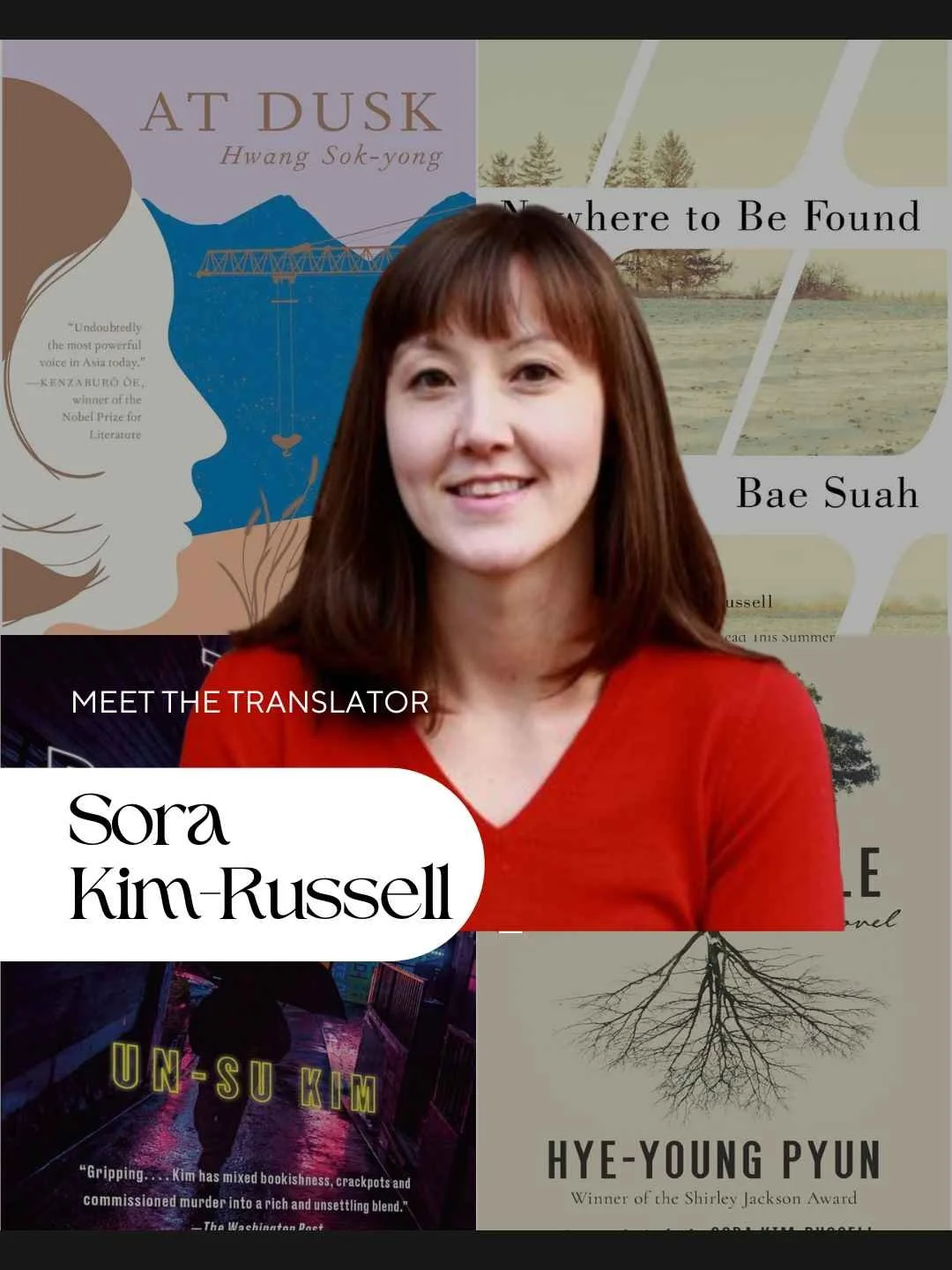
When I started figuring out what this translator project was really going to be about, I looked at the books on my shelves, who wrote them, and who translated them. Seems simple. It is Women in Translation Month, look at the women.
What was interesting to me was how familiar I was with the authors' names, but how rarely I had stopped to notice that some of my favorite books had been translated by the same person. Sora Kim-Russell was a name I had read many times. I just hadn't connected the dots.
Among the books I had already read were The Plotters by Kim Un-su, At Dusk by Hwang Sok-yong, The Hole by Pyun Hye-young, and Nowhere to Be Found by Bae Suah. I had also read Bae Suah's short story “Highway with Green Apples,” translated by Sora.
Five very different works by four very different writers, all translated by the same person.
That is why I have become so interested in following translators.
I know what draws me to certain authors. I am starting to wonder what happens when the same translator moves between them. What carries over? What changes? How much of what I respond to belongs to the writer, how much to the translator, and how useful is it to separate those things in the first place?
Sora’s newest translation, Hello Baby by Kim Eui-kyung, came out this month and is already on my list.
I was thrilled when I reached out to Sora and she quickly agreed to be part of this project of mine.
So, who is Sora Kim-Russell?
Sora Kim-Russell is a Korean-English literary translator based in Seoul. She has translated writers including Hwang Sok-yong, Pyun Hye-young, Kim Un-su, Bae Suah and Kyung-sook Shin.
Her translation of Pyun Hye-young’s The Hole won the 2017 Shirley Jackson Award for best novel. Hwang Sok-yong’s At Dusk was longlisted for the 2019 International Booker Prize, and Mater 2-10, which she co-translated with Youngjae Josephine Bae, was shortlisted for the International Booker in 2024.
She has also returned to some of the same writers across multiple books, which made her answer to my first question particularly interesting.
A conversation with Sora Kim-Russell
What’s it like working directly with authors as their translator? How close is that relationship, and has it changed how you approach the work?
“I actually tend to keep a certain distance from authors when I’m translating an initial draft, then I consult with them later, as necessary, during revision and editing. I tend to think of translation more as having a relationship with the book than with the person who wrote the book. Which isn’t to say that I don’t think about the author. Of course I do. I’ve been fortunate in getting to work with the same authors on multiple books, which has allowed me to see how their art and their obsessions develop over time. I take those developments into consideration as I work, along with what I know of the writers’ preferences, and of course my own experience of the text.”
— Sora Kim-Russell
The part that immediately caught me was having a relationship with the book.
I think I had pictured more back and forth between an author and a translator, especially when they had worked together more than once.
What I find even more interesting is what happens when she returns to the same writer.
She has the opportunity to watch their work change. She sees what they keep returning to and how those things develop. When she begins another translation, she is bringing that history with her.
And now that I realize I have read Sora translating Bae Suah more than once, this feels even more relevant. I am not only interested in what happens when I follow an author anymore. I am interested in what happens when the translator is following that author too.
Has being a woman shaped the kind of books you’re drawn to, or how you’re received in the industry?
“I don’t think being a woman has shaped what I'm drawn to so much as it shapes what other people think I should be drawn to! Maybe unsurprisingly, I’m drawn to writers who transgress expectations. Pyun Hye-young’s early work grabbed me partly because of her focus on toxic male protagonists. I admired the way she could dangle the possibility of sympathy while maintaining a critical narrative distance. I found it challenging but satisfying to translate.
As for how I’m received in the industry, other people have written about this in more detail, but translation tends to be treated as secondary or ancillary to writing. You see a lot of the same gendered and racialized forces at work here as anywhere else in terms of who gets recognition and who is expected to stay hidden, who is treated as creative versus who is treated as support staff. So while I haven’t been surprised by some of the challenges I’ve encountered, it does make it difficult sometimes to stick with it.”
— Sora Kim-Russell
Of course the Pyun Hye-young part jumped out at me because The Hole was already one of the Sora translations I knew and loved.
But it was the second half of this answer that I went back and read again.
Who is treated as creative versus who is treated as support staff?
That gets very close to what made me start paying closer attention to translators in the first place.
The author remains the author. Giving translators more credit does not diminish the author’s role. But the English text did not simply appear. Someone had to make thousands of decisions about how that book would exist in another language.
The more I learn about those decisions, the harder it becomes for me to think of translation as secondary creative work.
What’s one thing about doing this work that surprised you, or that people outside the industry don’t realize?
“One thing that surprised me back when I became a professional translator was the amount of unpaid work outside of the translation itself. Promoting the book you translated is part of it—and worth it if you’re earning royalties—but there can be a lot of other auxiliary tasks that you don’t see coming, such as translating emails, doing research, or being asked to step in as an interpreter. I try to warn aspiring translators of this, so they can better judge whether it’s something they’re willing to do. It’s basically a whole ton of care work on top of the paid work of translating a book.
As for what people outside the industry don’t realize, maybe a big one is that most translators probably aren’t thinking about “literal vs liberal” at all when they sit down to translate. I get the impression that non-translators think of the two as somehow repelling each other, like Literal Translation and Liberal Translation are doors that the translator must choose before beginning work, and once you step through you can never go back. But what counts as literal vs liberal is itself open to interpretation. Translating literature is more like making countless micro-decisions that are far more granular and nuanced than anything as clumsy and ill-defined as “literal vs liberal” could hope to capture.
One last thing that people on the outside don’t always realize is that not every part of a translation is the direct work of the translator. Books are edited, some very heavily, before they get printed. That one phrase in that one book that bugged you so much might not have even been the translator’s choice. The title that you hated might not have been the title they suggested to the publisher. (Likewise, the things you loved may have been just as much thanks to an astute friend or editor who saw the book before you did.) What you think was “lost in translation” might have been “deleted in editing” instead, but that’s a lot less fun to say!”
— Sora Kim-Russell
There is so much in this answer.
First, the unpaid work. Translating emails, doing research, interpreting, promoting the book. Sora calls it care work, and I think that is an interesting way to describe something readers almost never see.
Something else caught my attention because Shanna Tan brought up something similar when I interviewed her.
Shanna described herself as a literary translator, not a literal translator. Sora comes at the question differently and pushes back on the whole idea of “literal versus liberal” translation.
Two translators, two different answers, and both are pushing back against the same assumption: that translation is simply a matter of moving words from one language into another.
I think that says something about how often the work of a literary translator is misunderstood.
Sora describes it as countless small decisions involving tone, rhythm, ambiguity, voice, context and everything a sentence can imply without actually saying. Even deciding what counts as “literal” is more complicated than it might appear.
And then there is the editing.
This may be the thing from this entire conversation that changes the way I read translated books the most. I know books are edited. Obviously. But I had never really extended that thought far enough.
A title I dislike may not have come from the translator. A sentence I question may have changed during editing. Something I absolutely love may have been strengthened by an editor or another reader along the way.
I love this line:
“What you think was ‘lost in translation’ might have been ‘deleted in editing’ instead.”
Is there a question you wish I’d asked? What is it, and how would you answer it?
Sora chose her own question:
How has translation affected your own writing?
“I wrote a lot before I started translating. [Cue sad violins.] Then I tried to do both, but I found that translating inhibited my own writing. I gradually stopped writing entirely and poured all of that energy into translation instead. It didn’t feel like a sacrifice at the time, because I love translating and I was getting to translate books I really care about. But then I went on maternity leave and had my first real, extended break from translation, and everything I’d put aside all those years ago came rushing back. The experience taught me a lot about protecting my boundaries. The fact that it happened at the same time as becoming a mom—and learning how to not lose yourself entirely—was all the more poignant.”
— Sora Kim-Russell
I started these features because I wanted to know more about the people behind the books I was already reading. This is the kind of answer I never would have found by simply looking at a translator's bibliography.
This one is a window into her, not just her work. I found it incredibly human.
Reading Sora Kim-Russell
So far, the Sora Kim-Russell translations I know I have read are:
The Plotters by Kim Un-su
At Dusk by Hwang Sok-yong
The Hole by Pyun Hye-young
Nowhere to Be Found by Bae Suah
“Highway with Green Apples” by Bae Suah
And now Hello Baby by Kim Eui-kyung is sitting very high on my list.
There are many more. Sora has translated work by Kyung-sook Shin, Kim Bo-young and others, along with multiple works by Hwang Sok-yong, Pyun Hye-young and Bae Suah.
A complete bibliography would take me away from what I am actually interested in here. I would rather keep paying attention to the books I am reading, who wrote them, and who translated them.
Because now, when I see Sora Kim-Russell's name on another book, it won't just be a name. I will remember the person behind it.
Name the Translator
This profile is part of my ongoing series looking more closely at the translators behind the books I read.
The project started during Women in Translation Month because I realized that naming the translator was only the beginning. I wanted to know what they were actually doing, what they were thinking about as they worked, and whether paying attention to the translator might change the way I read.
It already has.
And I suspect the next time I am tempted to say something was "lost in translation," I am going to hear Sora in the back of my head asking whether it might have been deleted in editing instead.
