
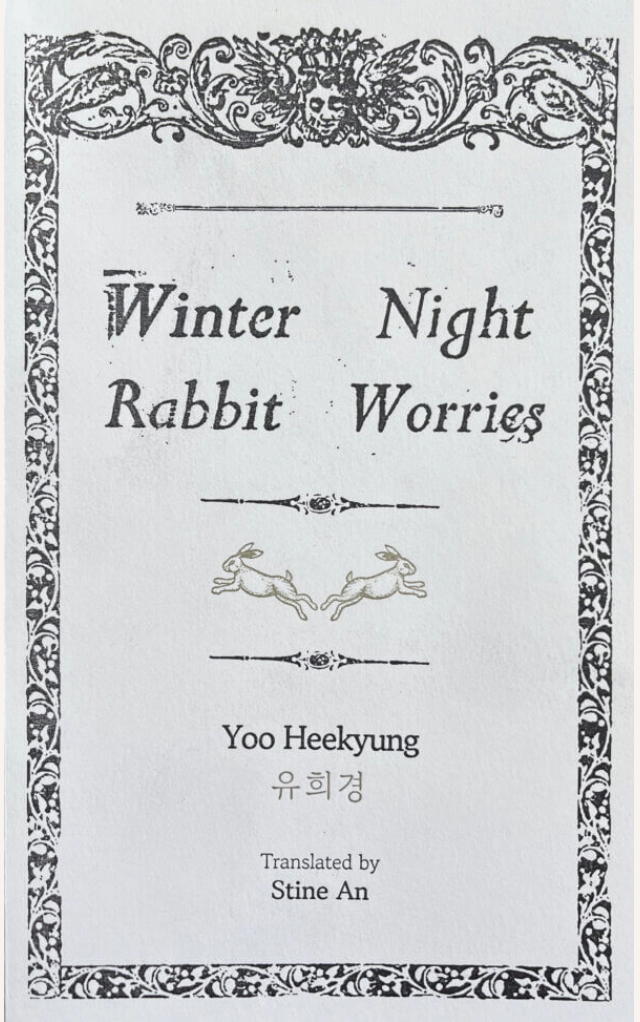
Winter Night Rabbit Worries
by Yoo Heekyung
Translated from the Korean by Stine An
Where to Purchase: Ugly Duckling Press
Ugly Duckling Presse
Publication Date: May 1, 2026
Winter Night Rabbit Worries begins with a rabbit that may not be a rabbit. Under a dim streetlamp, the speaker spots a small white object, long ears, red eyes, and calls out to no one in particular. Everyone, it's a rabbit. But no one is there, and the longer he looks the less certain he becomes. A white pebble. A discarded bread bag. By the end of the poem he has talked himself out of it entirely. And yet on bitter winter nights when the wind rattles the windows, he still worries. Is it too cold outside. Is the rabbit safe.
This, in a sense, sums up the book. Not the rabbit exactly, but the worrying about it anyway. The willingness to keep vigil for something you can't fully see or name, maybe not even real. Yoo Heekyung, translated from the Korean by Stine An, has written a book that asks you to read the same way. Stay with the uncertainty. Because what matters most, is that you stay with it.
This is not an easy book to read. I spent a lot of time thinking about each piece. It is not inaccessible. But even though the author calls each piece a "Story," they are really experimental work. Some are prose poems, some read like flash fiction, some resist any category entirely. A man becomes a desk on a rainy Monday morning. A woodpecker spends a summer in someone's room and leaves holes in their memory. Four passengers in a late night taxi add up to a lonely sum. The writing is subtle and strange and really makes you think.
I won't pretend I understood every piece. But somewhere around "Story — April 4th," a short gentle poem about potted plants turning instinctively toward rain, I stopped worrying about understanding and just read. The poem is simple. But it felt like it was giving me permission. Like Yoo Heekyung saying, just turn toward it. You don't have to understand rain to turn toward it.
After that I changed how I read. Less worried about decoding everything, more willing to just receive. Some pieces I understood completely. Some I am still thinking about.
One thing I noticed early was that every piece is titled "Story —" followed by the title. At first it just seems like a stylistic choice. But the more I read the more I started to think about that word. Story. Why is everything a story. What is he saying by calling it that.
I think the answer is in one piece called "Story — Story." A man named K presses his ear to a blank page in a book and hears something he can't quite understand. He doesn't leave. He just stays there with it. That piece felt like the instruction manual for the whole book. That's just how you have to read all of it. You stay with it even when you aren't sure what you're hearing.
And then there is one title that flips the pattern completely. Instead of "Story — [title]" it becomes "A long interval — Story." The only time Story comes at the end. In this case, maybe the interval isn't a gap in the story. It's where the story comes from. I think that was done on purpose.
I also want to talk about the translation because I think it deserves its own attention. Stine An is not just a translator here, she is a collaborator. Her translator's note at the back of the book is worth reading carefully. She writes about growing up as a Korean immigrant child in America, sleeping with a dictionary by her bedside, hoping that if she knew enough words she could make sense of the world. That child with the dictionary is in every page of this translation.
There were moments in my reading where I wasn't sure if a word choice or a sentence structure was experimental writing or a translation decision. Korean and English don't map onto each other cleanly. Not knowing for sure never frustrated me though. If anything it felt right for a book that asks you to accept the uncertainty. And the fact that Stine's note opens with the etymology of the word etymon, meaning true or real or actual, and the very first poem is called "Story — Etymon," tells you everything about how carefully she worked through this collection. She picked up the thread from the very first page. I think it is clear she knew what she was doing.
I will be honest. When I finished this book I wasn't sure I was up to the task of writing about it. Not because I felt defeated but because I wanted to do it justice. I spent a lot of time with it after I closed it. Thinking about the rabbit. Thinking about K and his empty page. Thinking about that one title that breaks the pattern.
What I kept coming back to is that this is a book that rewards the time you give it. It will not hold your hand. It is more like a mumble than a shout. Quiet and strange and working on you slowly. I really think that is exactly what Yoo Heekyung was hoping for.
If you are a reader who loves experimental writing, or who has ever read a poem and not fully understood it but felt something anyway, this book is for you. If you are curious about Korean literature beyond the novels and the more straightforward poetry collections, this is a very different experience and I think a valuable one. Give it time. Stay with it. Press your ear to the page like K did.
Because what matters most, is that you stay.
I received an advance review copy of this book from Stine An. All opinions are my own. (Thank you)
If you like this you may also like
If you liked this:
If you want to explore more Korean poetry in translation, I highly recommend Lady No by Kim Hyesoon, translated by Jack Saebyok Jung. It is a very different experience. Fierce and overwhelming compared to the quiet subtlety of this book. You can read my full review here.
If you want to explore more of Yoo Heekyung's work in English, Stine An has also translated his earlier collection Today's Morning Vocabulary, published by Zephyr Press. I haven't read it but it feels like a natural next step for anyone who connects with Winter Night Rabbit Worries.
Stine An is also a poet in her own right. Her collection S_MMER CR_SH is published by Sarabande Books. I haven't read it either, but for anyone who was moved by her translator's note and wants to follow her voice further, it seems worth knowing about.
