
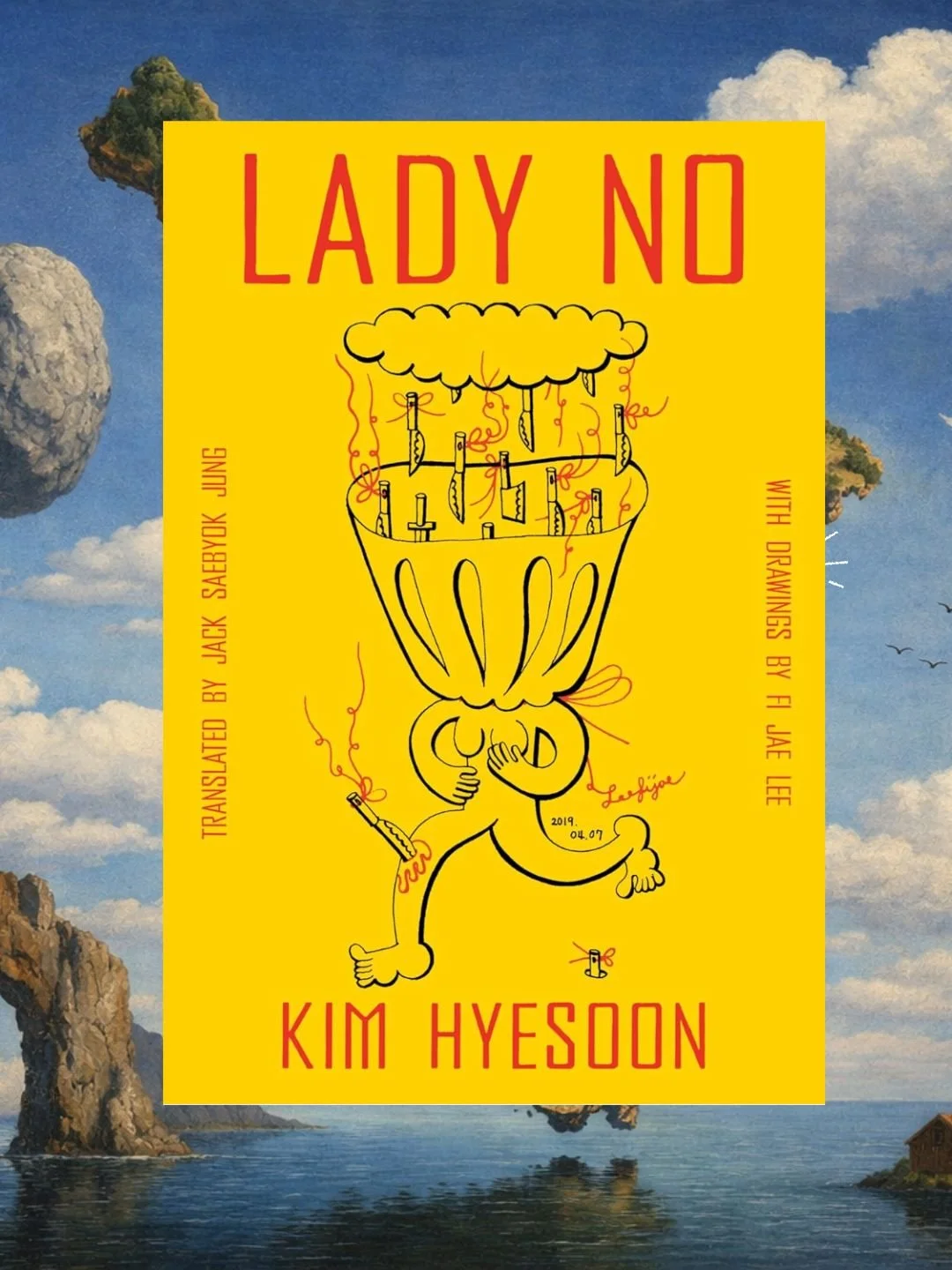
Lady No
by Kim Hyesoon
Translated by Jack Saebyok Jung
With drawings by Fi Jae Lee
Ecco | April 14, 2026
What It's About
What if a country could be held up to a mirror and made to answer for itself? In Lady No, South Korean poet Kim Hyesoon does exactly that, and she names what she sees Aerok. Korea, spelled backwards. A country where, she insists, everything is backwards: the laws, the politics, the rules that govern women's lives and women's voices. It is a simple, devastating linguistic sleight of hand, and it sets the tone for everything that follows.
In March 2014, Kim Hyesoon began posting anonymously to the blog of Munhakdongne, a major South Korean publisher, writing not as herself but as Lady No. That act of anonymity was itself a statement. One of South Korea's most decorated poets, hiding in plain sight, saying things she needed a mask to say. Now, those 179 entries, collected here in their entirety for the first time and featuring 34 drawings by artist Fi Jae Lee, arrive in English translated by Jack Saebyok Jung. The timing couldn't be more fitting: Lady No publishes on April 14th, right in the heart of National Poetry Month.
What makes this collection extraordinary is its refusal to behave. These texts defy classification as either poetry or prose. Kim Hyesoon calls them shisanmun, literally "poetry-prose," an ungovernable hybrid of vignettes, editorials, riddles, travelogues, and outright poems.
What Stuck With Me
One moment you are reading something that feels like a fever dream, the next a sharp political argument, the next a meditation on what it means to teach poetry in a country that has historically used confession as a tool of torture. The "Aerok Fiction Factory" is one of the collection's most chilling pieces, describing a place where beatings produce works of fiction, where the only command is Confess! Confess! Confess! She is not speaking metaphorically. She is speaking about Korea's history of authoritarian violence, and she is speaking about it with the cold clarity of someone who lived through its aftermath.
Kim has long been described as writing feminist surrealism "loaded with shifting, playful linguistics that both defile and defy traditional roles for women." That description is accurate, but it doesn't quite prepare you for the experience of reading her. "Wedding March" is one of the poems worth returning to again and again. It asks why women willingly step onto the stage of misfortune, why they put on what she calls "the noose of the medal called sorrow." It is tender and furious. Lady No thinks the wedding march is the saddest song in the world, and by the time you finish the poem, you may agree.
Her critique of academia carries the same dual edge. Kim has spent decades teaching creative writing at the Seoul Institute of the Arts, and she writes about the literary world from the inside. Full of hierarchies, gatekeeping, and particular cruelties toward women writers.
Kim Hyesoon was the first woman poet to receive the Kim Su-yeong Literature Award, the Midang Literary Award, and several other major Korean prizes, and yet Lady No was written in disguise, published anonymously, as if even she needed the cover of a persona to say what needed saying. There is something quietly heartbreaking about that. Lady No is a dissenter, survivor, professor, feminist, and poet all at once. Fi Jae Lee's ink illustrations are filled with the same strange energy as the writing itself.
Jung is a 2024 National Endowment for the Arts Translation Fellow and a Truman Capote Fellow at the Iowa Writers' Workshop. His translation preserves what he calls Kim's "fierce strangeness."
My Takeaway
Take your time with this book. There is so much in it. This book has moments that land like a punch. But it is also full of intelligence, humor, fury, and insistence that poetry is not a luxury but a form of survival. Lady No is such an important collection. You will be left thinking about Aerok, that backwards mirror country, for a long time to come. So worth the read.
Where to Purchase
If you liked this, you might also enjoy:
The White Book by Han Kang: another Korean writer who dissolves the boundary between poetry and prose, building a meditation on grief, identity, and the weight of what a country leaves behind.
Night Sky with Exit Woundsby Ocean Vuong: fierce, tender, and politically alive, Vuong's debut collection shares Kim Hyesoon's refusal to separate the personal body from the political one.
Studies of Sorrow by Shangyang Fang: translated poetry that sits in the same transnational, formally restless space as Lady No, for readers who want to keep going deeper.
This post contains affiliate links. If you purchase through my link, I may earn a small commission at no extra cost to you. I only link to books I have read and recommend.
