
Troubled Waters
by Ichiyo Higuchi
translated by Bryan Karetnyk
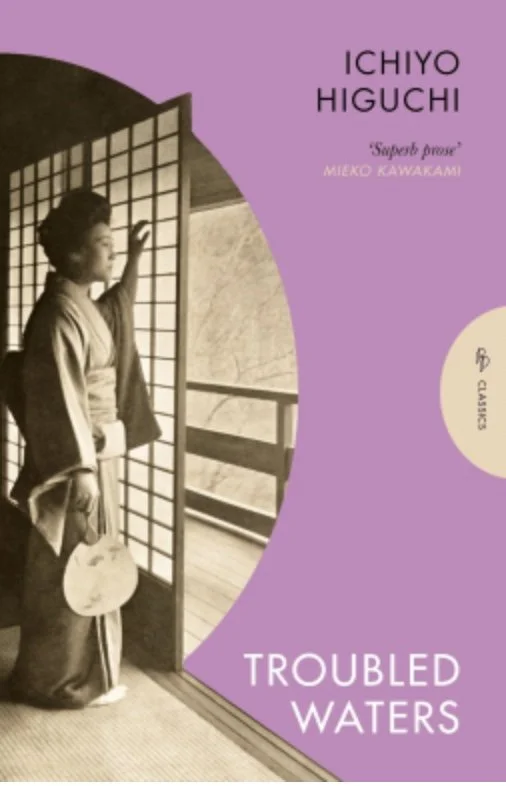
ARC Review
Publisher: Steerforth & Pushkin | Pushkin Press Classics
Publish Date: May 26, 2026
What It’s About
Troubled Waters is a collection of five short stories by Ichiyo Higuchi, considered Japan’s first professional woman writer. These stories are set in turn-of-the-century Tokyo, among working-class communities and the red-light district, where money and social position shape nearly everything.
This edition includes a new translation by Bryan Karetnyk, with several stories never before translated into English. Two of the standouts for me were the title story “Troubled Waters” and the famous coming-of-age story “Growing Pains.”
What Stuck With Me
This was my first time reading Ichiyo Higuchi, and I didn’t expect to love it as much as I did.
These stories are sharp and deeply human, but they don’t feel performative. There’s no sentimentality layered on top to guide your emotions. Higuchi just shows you people living inside their circumstances, and it feels honest.
“Troubled Waters” and “Growing Pains” were the two standouts for me, and in both cases it was the women who pulled me in. They’re written as real, not heroic or inspirational. They have agency, they have pride, and they’re also living inside systems that can turn on them quickly.
Oriki, in “Troubled Waters,” was especially memorable. She knows how to hold power in a room and keep men at a distance, even when they feel entitled to her. But you can still see the fear underneath it. That tension between strength and fragility felt so true. She chooses independence, even when there are easier options, but she also knows how dangerous a man can become when he feels rejected or humiliated. The ending is almost delivered like an aside, like “and then something terrible might have happened,” and somehow that made it hit harder. The story isn’t trying to shock you. It’s showing you who Oriki is and what it costs her to live the way she does.
“Growing Pains” was beautiful in a different way. Midori’s childhood already has an expiration date, and everyone around her knows it, even if she doesn’t want to. Her relationships with the boys she grew up with were written with so much warmth, and then you start to feel the shift. Desire shows up. Jealousy creeps in. Her friends start seeing her differently. She starts feeling things she can’t name yet. It’s not dramatic, it’s just inevitable. The writing captures that quiet confusion of becoming a young woman, and realizing the world is reacting to you differently before you fully understand why.
And beyond the characters, the physical detail is what made everything feel so vivid. The clothing, the hair, the way women are prepared for festivals or moving through the streets. It is more than decoration. It signals class and vulnerability. You can picture these women. You can see how they’re being seen.
The translation deserves credit too. It was very readable, it flowed naturally, and I loved the footnotes and appendix. There are references here I would have missed completely without that context. If anything, it made me want to keep reading more from this period, because each book starts laying groundwork for the next.
What stayed with me most is how alive these women felt on the page. They were just fully themselves, even inside lives that are far from free.
Would I Recommend It
Yes. Absolutely.
If you like historical fiction, especially stories about women’s lives in history, this is worth your time. If you like Japan as a setting, or you’re curious about the social world surrounding courtesans, poverty, and working-class Tokyo, you’ll probably be locked in.
And if you’re building your own reading path through Japanese classics, this feels like a perfect entry point. It has emotional power, but it also gives you context.
Thank you to Pushkin Press Classics and NetGalley for the digital review copy.
If you like this you may also like:
Life of an Amorous Man by Ihara Saikaku (Edo period): a strong complement as a male perspective from an earlier era.
Third Love by Hiromi Kawakami: a more modern book, but it felt like it echoed parts of this world. Like looking back through time from the present.
