
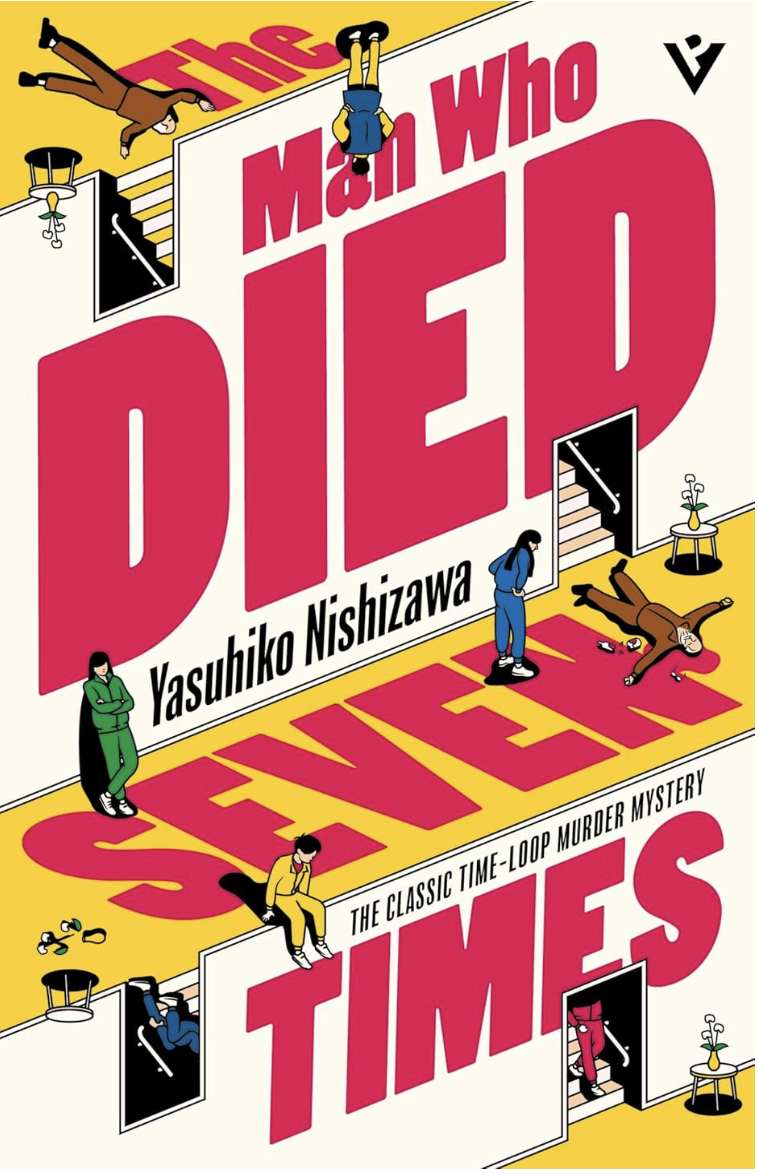
The Man Who Died Seven Times
by Yasuhiko Nishizawa
translated by Jesse Kirkwood
Purchase on Bookshop.org , Amazon, Libro.fm
This post contains affiliate links. If you purchase through my link, I may earn a small commission at no extra cost to you. I only link to books I have read and recommend.
Pushkin Vertigo, 2025 | 224 pages | March 2026 Fable Book Club Pick
What It's About
The Fuchigami family has gathered for New Year celebrations at the family estate. There is an inheritance at stake, obligations to observe, and a house full of relatives who have complicated feelings about all of it. By the end of the first day, the grandfather is dead.
Hisataro, our teenage narrator, has an unusual condition. Occasionally, against his will, he falls into a time loop. He relives the same day nine times while everyone around him resets, carrying the full weight of every memory alone. He has never had much use for this ability. Until now he has seven chances to figure out who killed his grandfather before the loop ends for good.
The Man Who Died Seven Times belongs to the shin-honkaku tradition of Japanese mystery writing, a movement that prizes the architecture of the puzzle above character depth or social realism. It is Yasuhiko Nishizawa's English-language debut, translated by Jesse Kirkwood for Pushkin Vertigo, and it is the first of Nishizawa's 100-plus Japanese books to reach English readers.
What Stuck With Me
Time-loop fiction is not usually my format. The structure tends to tire me out. Sitting through the same events again because the author needs you to is a real risk, and most books in this mode lean too hard on the repetition rather than the variation.
Nishizawa sidesteps this almost entirely. What keeps the loops alive is the comedy. Each iteration escalates in a slightly different direction. Hisataro's interventions produce new problems, new absurdities, new characters behaving badly in new ways. The novel gets increasingly farcical as the loops stack up, and Nishizawa leans into that fully. The joke is not that the same thing keeps happening. The joke is that it keeps going differently wrong.
The shin-honkaku context matters for setting expectations. This is a tradition that openly values the puzzle over psychological depth. The characters are functional rather than fully drawn, and that is by design. Nishizawa belongs to a movement that considers the architecture of the mystery an art form in itself. If you go in expecting interiority and emotional weight you will be disappointed. If you go in asking how does this thing work, you will be very satisfied.
The origin story is worth knowing: Nishizawa has said he got the idea after watching Groundhog Day, wondering what would happen if a detective were caught in the loop instead of Bill Murray. That a Hollywood comedy inspired a novel this formally rigorous says something about how seriously shin-honkaku writers take their premises. The premise is a gift. Nishizawa uses it well.
Jesse Kirkwood's translation is smooth throughout, functional and fast-moving, which is exactly the right register for a novel that wants to keep you turning pages rather than admiring sentences. The book sat untranslated for decades before Kirkwood brought it to Pushkin Vertigo. Now that it is here, you understand immediately why it was worth the wait.
One small note on the ending: there is a romantic subplot involving Hisataro and a character named Emi, and the resolution lands a little awkwardly given the age gap between them. It does not derail the book. It is a raised eyebrow, not a reason to stop reading. But it is worth knowing going in.
My Takeaway
If time-loop fiction has never worked for you, this may be the exception worth making. Yasuhiko Nishizawa's The Man Who Died Seven Times is slick, funny, and built with real care. It does not ask you to feel deeply. It asks you to pay attention. Those are different pleasures, and this book delivers on its.
It is ideal for readers who love puzzle mysteries, who want Japanese fiction that sits on the lighter end of the register, or who are curious about the shin-honkaku tradition and want an accessible starting point. It knows exactly what it is, and it is very good at being that thing.
Yasuhiko Nishizawa has written over 100 books in Japanese. This is the first to reach English readers. That gap should make us all a little restless.
If you liked this book, you might also enjoy:
The Tatami Galaxy by Tomihiko Morimi: a more surreal treatment of looping structure in Japanese fiction, with more literary ambition and stranger edges
This post contains affiliate links. If you purchase through my link, I may earn a small commission at no extra cost to you. I only link to books I have read and recommend.
