
Han Kang
Where to Start With Her Books
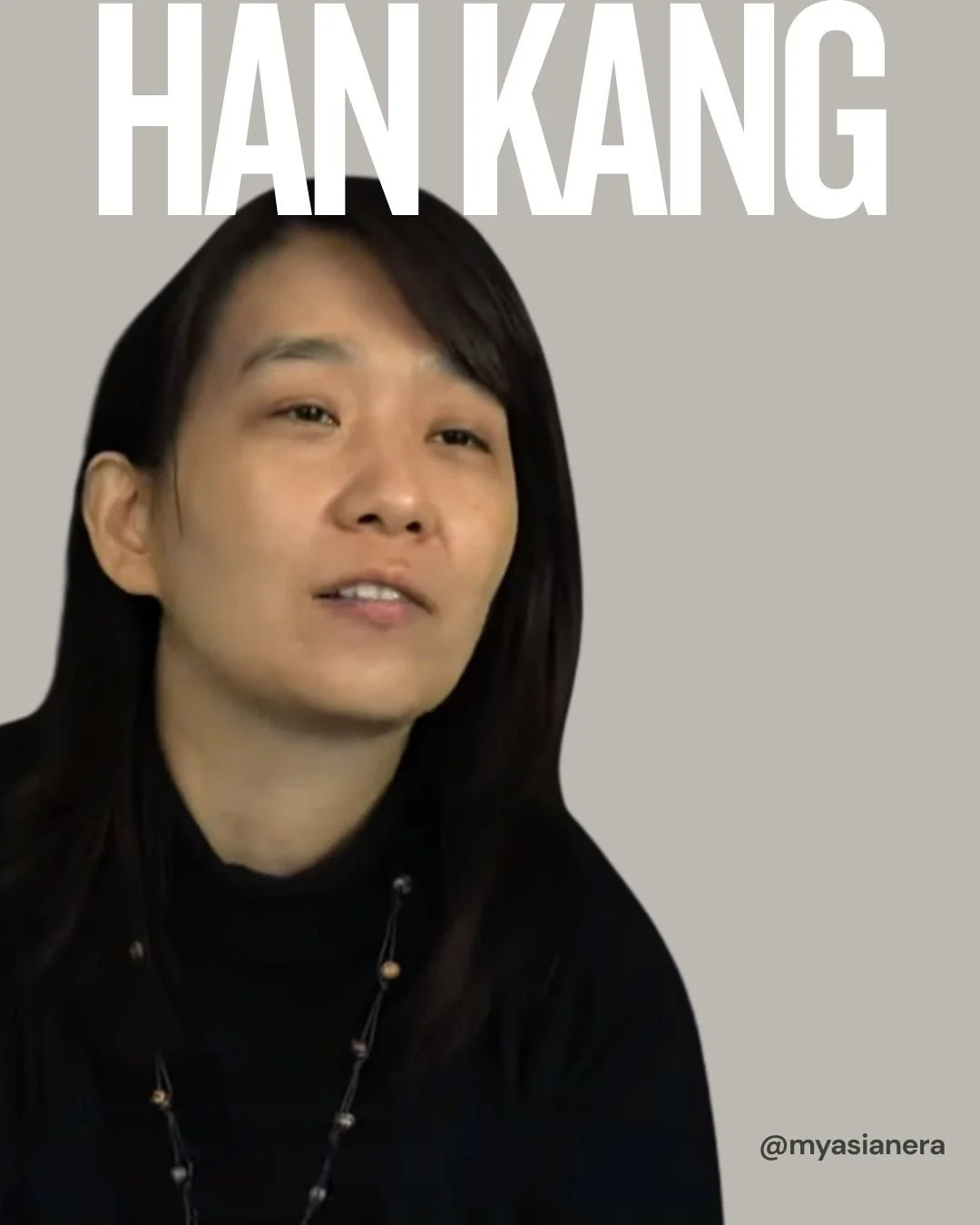
Image Source: librairie mollat, CC BY 3.0 <https://creativecommons.org/licenses/by/3.0>, via Wikimedia Commons. This post contains affiliate links. If you purchase through my links, I may earn a small commission at no extra cost to you.
In October 2024, Han Kang (한강) became the first Korean and the first Asian woman to win the Nobel Prize in Literature. The Nobel committee cited her "intense poetic prose that confronts historical traumas and exposes the fragility of human life." I was in Seoul shortly after the announcement and watched what that looked like in person. At Kyobo, a huge bookstore I love to visit because it has the largest collection of Korean authors in English translation I have found anywhere in my travels, the shelves were emptying. People were buying her books as fast as they could be restocked. It was extraordinary to stand there and watch it happen.
Han Kang was born in 1970 in Gwangju, a city in the southwest of South Korea that carries enormous weight in modern Korean history. She grew up in a literary household: her father, Han Seung-won, is one of Korea's most respected novelists. She made her fiction debut in 1993, began publishing short stories and novels through the late 1990s and 2000s, and has been one of Korea's most closely watched writers for decades. The Nobel Prize was not a surprise to Korean readers. It was a confirmation of something they already knew.
Some time after that Seoul trip, I found a complete set of her novels in a tiny bookshop in a small town in Sardinia. Her books have traveled that far. That tells you something about what she has done.
What She Writes
Her subject, across everything she has written, is what human beings do to each other. Not in the abstract, but in the specific: a body searched, a city suppressed, a woman made to disappear into her own marriage.
Her first published works were poems. Five appeared in the quarterly Literature and Society in 1993, a year before her fiction debut. You can see it in her prose. Short sentences. Precision. She uses second-person narration in Human Acts with an almost forensic precision. The "you" on the page implicates the reader in what is happening. Reading her is an active experience. She is good at drawing you in.
Something to know before you start: Han Kang's novels are rooted in specific Korean histories that some Western readers will know deeply and others will not know at all. She does explain what is necessary within the text. But books like Human Acts and We Do Not Part carry additional weight for readers who know how recently these events could be spoken about in Korea, and what it meant to live with that silence. Reading the history after you finish the book changes what you just read.
The Books
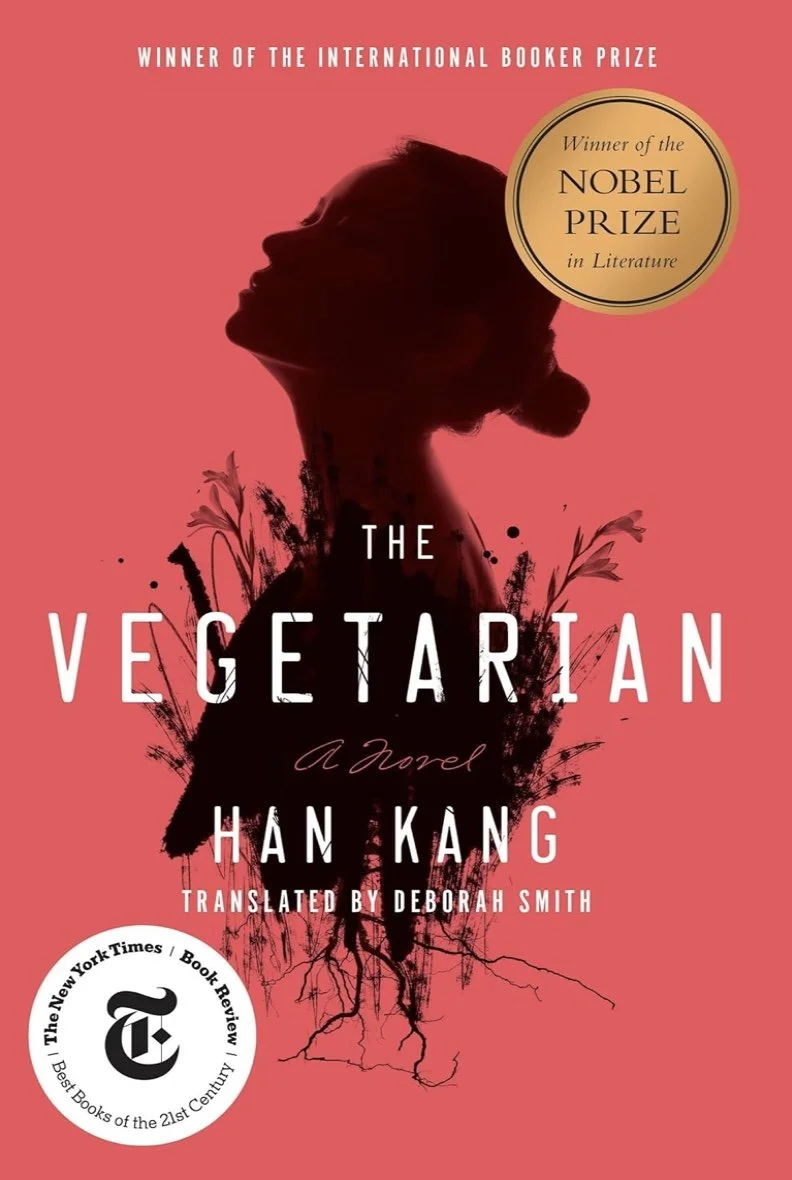
The Vegetarian (trans. Deborah Smith, Hogarth Press, 2015)
Told in three parts from three perspectives, each circling a woman named Yeong-hye who decides, after a violent dream, to stop eating meat. What follows is not a story about food. It is a story about what happens when a woman in a conventional Korean marriage begins to refuse the shape of the life she has been given. Her family treats this refusal as illness. Her husband treats it as embarrassment. None of the narrators are Yeong-hye herself. That distance is the whole architecture of the book.
The Vegetarian won the International Booker Prize in 2016 and is the book that introduced Han Kang to most Western readers. It is her most disturbing work. The book escalates. By the third section, what began as a refusal to eat has become something else entirely.
A friend recommended it to me well before the Nobel Prize. I finished it horrified. It is visceral and dark and breathtaking. There were moments that angered me and others that made my skin crawl. I had to read more of her work after that.
Human Acts (trans. Deborah Smith, Hogarth Press, 2016)
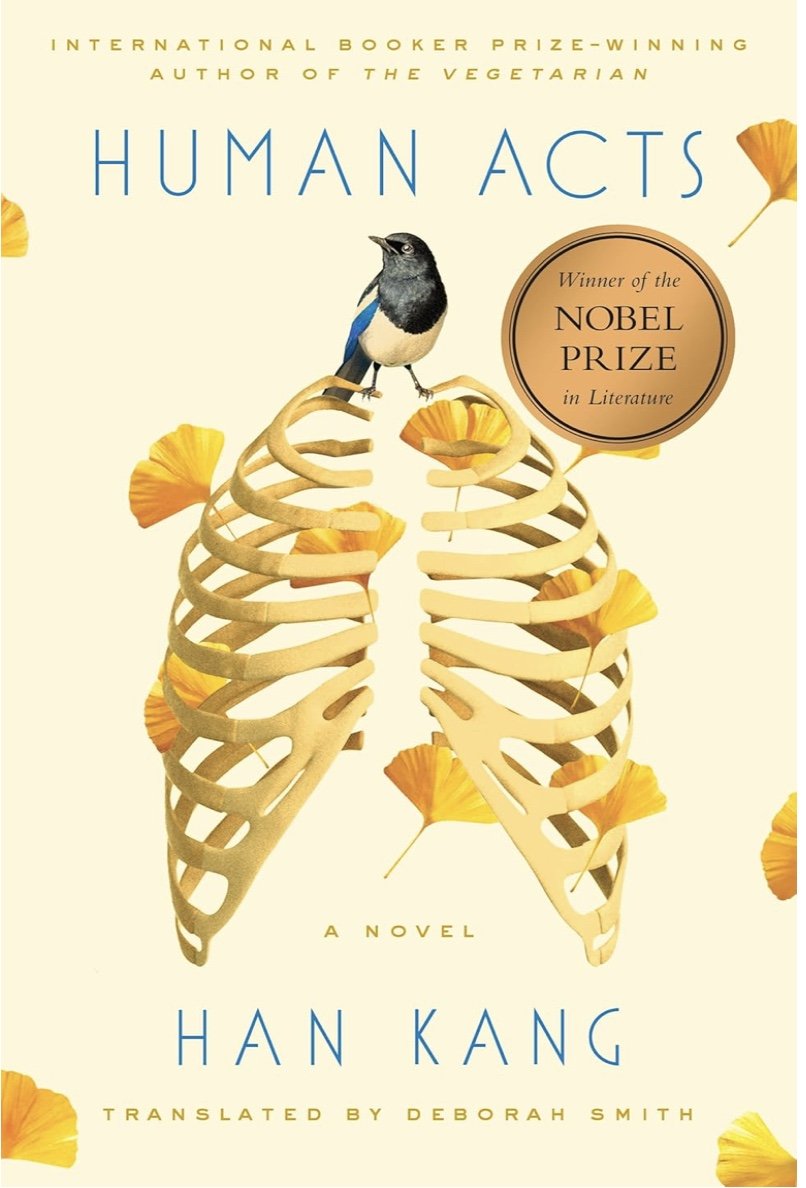
In May 1980, the city of Gwangju rose up against the military dictatorship that had seized power in South Korea following the assassination of President Park Chung-hee. The uprising was crushed. Hundreds of civilians were killed, many more were detained and tortured, and the events were suppressed in official Korean history for years afterward.
Han Kang was born in Gwangju. Her family left for Seoul when she was young, but the city stayed with her. Human Acts is her reckoning with what happened there. It moves across multiple narrators and multiple decades, following the lives touched by a single boy who died in the uprising. It is the most devastating book she has written, and one of the most important works of Korean literature in any language.
I was already familiar with the history of the Gwangju Uprising before I read it. That did not prepare me. There is a particular grief that comes from reading something you thought you understood and realizing you had only known it at a distance. Human Acts closed that distance. The tears and sorrow I felt reading it are not something I can fully explain. Devastatingly beautiful is the only phrase that comes close.
The White Book (trans. Deborah Smith, Hogarth Press, 2017)
More meditation than novel. Han Kang structures this book around white things: snow, rice, salt, a newborn wrapped in cloth. Threading through the list is her older sister, who was born two months premature and died within hours. Han Kang considers what it means to have lived in a life that was originally meant for someone else.
It is her most formally experimental work in English and also her most personal. I read it after Greek Lessons and loved it deeply. She is a poet first, always, and this book shows it most clearly. She makes her statements boldly and shares the depths of her pain without flinching. Some readers find it difficult. I found it full in a way that very few books are.
Greek Lessons (trans. Deborah Smith and e. yaewon, Hogarth Press, 2023)
A woman has stopped speaking. A man teaching ancient Greek is losing his sight. They find each other in a classroom in Seoul. Two people at the outer edge of their ability to communicate, reaching toward each other anyway. Han Kang is clearly interested here in the question of what remains when words stop working, and the answer she gives is worth the whole book.
One detail worth sitting with: the woman has lost her ability to speak in Korean, her native language, but she can still communicate in others. She is not mute. She has lost something specific to her mother tongue. And the class she has enrolled in is ancient Greek, a language nobody speaks as their first language anymore. That choice is not accidental.
The reading I keep coming back to: she cannot speak her own language but reaches toward another. He cannot see what is happening right in front of him. Two different failures to witness, finding each other across a classroom. This book felt softer to me than her others, but the statement it was making was loud and clear.
We Do Not Part (trans. e. yaewon and Paige Aniyah Morris, Hogarth Press, 2025)
Her most recent novel is also her most recent confrontation with Korean history. The Jeju April 3rd Incident, known in Korean as 제주 4·3, began in 1948 and continued until 1954. During that period, tens of thousands of Jeju islanders were killed by South Korean military and police forces in a mass suppression of suspected communist activity. It was effectively silenced in South Korea for decades and is still not widely known outside Korea.
We Do Not Part begins with a woman in Seoul receiving a request from a friend on Jeju, recovering from surgery, who needs her bird fed. What it becomes is a book about memory, solidarity, and the weight of a history a country has tried to forget.
My advice to every reader going in: keep going through the snow. You will get to the other side. Or you won't. Either way, you needed to make the attempt.
Short Works and Other Writing
Han Kang has written across forms her whole career, and several shorter works are available in English that tend to get overlooked.
Convalescence (trans. Jeon Seung-hee, ASIA Publishers, 2013) is a bilingual novella, English and Korean in the same volume, about a woman with a wound that refuses to heal and the ghost of her dead sister. I found my copy at Kyobo during that Seoul trip right after the Nobel announcement, sitting quietly on a shelf. I had never heard of it before. I bought it on the spot. It is difficult to find outside Korea but very much worth searching for.
Europa, Han Kang's contribution to the YEOYU series published by Strangers Press (UEA), is a chapbook funded by the Literature Translation Institute of Korea. The YEOYU project brought together eight South Korean writers, each in a distinct handmade volume. Once I found out it existed, I had to hunt for it. I kept seeing it on Instagram and could not track down a copy. I finally found one through a UK bookshop online. I was traveling to England at the time, so I ordered it and had it shipped to the hotel. It was waiting at the front desk when I arrived. Han Kang's story "directs her unflinching gaze on the painful complexities of damage and recovery," and the voice is noticeably different from her novels. Worth knowing going in, and worth every bit of the hunt.
And on March 24, 2026, Hogarth publishes Light and Thread, her first work of nonfiction in English. The collection includes her Nobel Lecture, essays, poems, photographs, and diary entries, translated by Maya West, e. yaewon, and Paige Aniyah Morris. For readers who want to understand how she thinks about her own work, this is the book to read alongside the novels. It is nonfiction, which is new territory for her in English. I cannot wait.
She has also written children's books in Korean, though none appear to be available in English translation yet.
If you want a free entry point before committing to a full book, Words Without Borders published an excerpt from The Vegetarian in 2014 that is still available to read online at wordswithoutborders.org. Another interesting piece is The Fruit of My Women a short story made available through Granta and also included with some of the Vegetarian editions indicating it was where she started to develop with idea for the Vegetarian.
On Translation
Most of Han Kang's work in English was translated by Deborah Smith, whose translations prioritize lyrical English prose. Some Korean scholars have argued this comes at the cost of fidelity to the original. Han Kang's two most recent novels (Greek Lessons and We Do Not Part) involved e. yaewon, a Korean-English translator who works closely with the source text, and the translation register does feel different. Both approaches produce books worth reading. If fidelity to the source matters to you, the e. yaewon translations are the place to start.
Where to Start
If you want to understand what the Nobel committee meant, read Human Acts. It is not the easiest entry point but it is the fullest expression of what she does, and the historical context of the Gwangju Uprising is something your reading life should include.
If you want to begin with something shorter and more contained, The Vegetarian is where most Western readers started and it will tell you quickly whether her work is for you.
If you want to start with what she is doing right now, We Do Not Part is her most recent novel, and Light and Thread, her Nobel collection, publishes this month.
Just start. The order matters less than you think.
This post is part of a Women's History Month author spotlight series on Asian female writers.
All her books are available on my storefront.
