
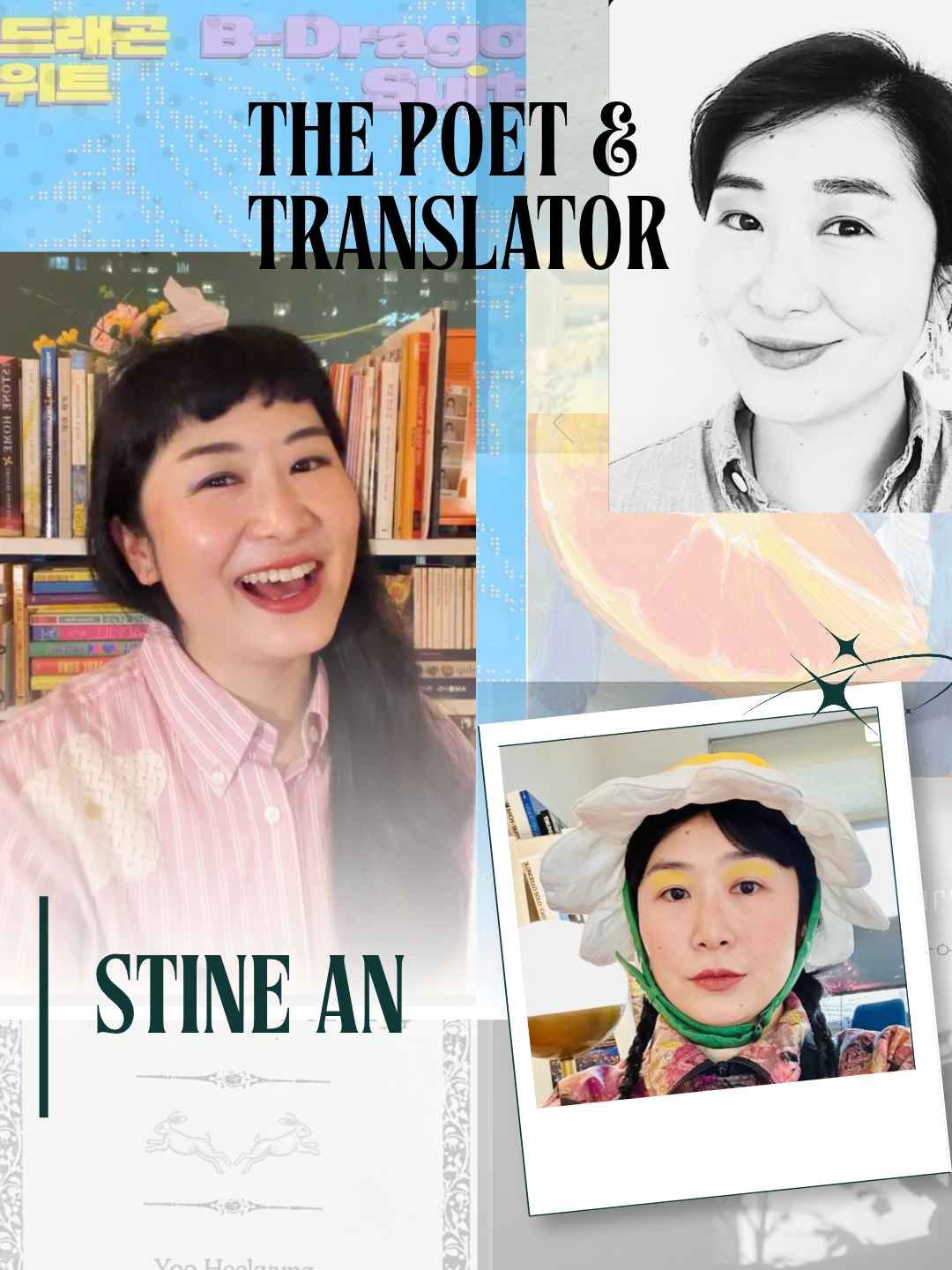
Stine An, poet, literary translator, and performer. Photographs sourced from Stine An's Instagram; collage by My Asian Era.
On language, poetry, and the art of creative collaboration
I first discovered Stine An through her translation of Yoo Heekyung's Winter Night Rabbit Worries. I was fascinated by the poetry and by the work that goes into bringing something so deeply connected to one language and culture into another.
Since then, I've had the pleasure of getting to know Stine a little, and the more I discover about her work, the more interesting she becomes.
Stine is a poet and literary translator whose creativity seems to find its way into everything she does. Her translations of Yoo Heekyung's Today's Morning Vocabulary and Winter Night Rabbit Worries introduce English-language readers to contemporary Korean poetry, while her own work, including S_MMER CR_SH and her recently published B-Dragon Suite, explores language in wonderfully inventive ways.
I recently finished B-Dragon Suite, and what an experience it was! K-pop, Korean mythology, linguistic experimentation, humor, and some unexpectedly moving family histories all coexist in a collection that continually challenges what poetry can look and sound like.
What interests me most about Stine's work is the relationship between her two creative practices. Writing poetry and translating poetry require different kinds of attention, but both involve making choices about language, meaning, rhythm, and expression. Translation is an art in its own right, something I wish more readers recognized.
When Stine agreed to participate in My Asian Era's Name the Translator series, I wanted to learn more about those creative choices, her relationships with the poets she translates, and what keeps her doing work that can be both personally rewarding and professionally difficult.
She gave me wonderfully thoughtful answers, including a fourth question of her own.
Meet Stine An
Stine An is a poet, literary translator, and performer based in New York City. Her work explores diasporic poetics, experimental translation, and the possibilities of language across literary forms.
She has received a PEN/Heim Translation Fund Grant and a National Endowment for the Arts Translation Fellowship. Her writing and translations have appeared in Words Without Borders, Poem-a-Day, Electric Literature, and Best Literary Translations. She holds an MFA in Literary Arts from Brown University.
Her book-length work includes:
As a translator:
Today's Morning Vocabulary by Yoo Heekyung (Zephyr Press, 2025)
Winter Night Rabbit Worries by Yoo Heekyung (Ugly Duckling Presse, 2026)
As a poet:
S_MMER CR_SH (Sarabande Books, 2025)
B-Dragon Suite (Nightboat Books, 2026), winner of the 2023 Nightboat Poetry Prize
In the afterword to Today's Morning Vocabulary, which Stine generously shared with me, she reflects on her path toward translation and her relationship with language. It's a particularly meaningful companion to this conversation because it offers a more personal look at how translation became part of her creative life.
I originally invited Stine to participate in this series during Women in Translation Month in August. Although our conversation took place then, I'm sharing it now alongside the publication of her poetry collection, B-Dragon Suite. Having spent so much time exploring her poetry since our original exchange, I find her reflections on translation and creativity even more meaningful.
In Conversation with Stine An
1. What's it like working directly with authors as their translator? How close is that relationship, and has it changed how you approach the work?
It’s been incredibly meaningful and inspiring. I love that translation is collaborative. You’re already collaborating with the original text. When I work directly with authors, I get to learn about the person behind the work, ask questions about how they think about poetry, and grow as a poet myself while getting to know their poems.
I worked closely with poet Yoo Heekyung on my first two full-length translation collections, Winter Night Rabbit Worries (Ugly Duckling Presse, 2026) and Today’s Morning Vocabulary (Zephyr Press 2025). The work of literary translation can be lonesome and daunting. Yoo Heekyung was so generous in sharing his time and knowledge with me for both projects. He’d answer any questions I had, give me space for my own interpretations and lyricism, but provide context when I needed it. One reason I started translating his work was that he seemed like an interesting person with a distinct perspective on poetry. Poet Yoo runs a poetry bookshop and programs literary events, in addition to his experience as a literary editor, so I thought he’d be a great person to learn from about contemporary South Korean poetry and publishing culture. We’ve collaborated on several projects to share South Korean poetry in creative ways, including a LitHub piece on reading Korean poetry through music and a multi-city tour in New Orleans, Boston, and NYC featuring several contemporary South Korean poets and their translators.
I haven’t worked as closely with every writer I translate, but that’s about capacity, not interest. There’s no money in literary translation, especially for poetry, and publishing Korean poetry in English is difficult, so I need to get something meaningful out of a project. I’m motivated by knowledge and growth, so I translate poets I want to learn from as writers, people, and community members. I hope to build friendships with most of the writers I translate. More interesting, collaborative work is possible through friendship.
2. Has being a woman shaped the kind of books you're drawn to, or how you're received in the industry?
I’ve been reflecting on my relationship to gender lately. In their queer translation toolkit, writer and translator paparouna reminded me that “genre is, after all, the French word for gender, and gender-bending is also genre-bending.” So, I’ve been thinking about and questioning both genre and gender a lot over the past few years. I’m still working through what all this means for me, but I’ve been socialized as a woman and have been performing that gender for most of my life, and I’m still perceived as a woman, more specifically as an East Asian woman, in many contexts. And being perceived as a woman has likely affected my reception as a writer and translator in countless ways, similarly to how translating work that is labeled as poetry has affected my experiences and reception in the industry. The marginalization comes from multiple directions—lucky me.
As for the texts I’m drawn to, I tend to gravitate toward work that questions genre, or even questions what poetry can be and look like. It was actually through literary translation that I came to understand my own queerness. So I try to find writers who offer something more expansive through their work. The writers might not identify as queer themselves, but there’s still an opportunity to write and translate toward a more expansive sense of self, or what writing can be. One of my core values as a writer and translator is to create and publish work that makes more possible in the world for other readers, writers, and translators.
3. What's one thing about doing this work that surprised you, or that people outside the industry don't realize?
Literary translation is really hard and thankless work. Had I known how discouraging the work would be, I don’t know if I would have tried. Not because I couldn’t or didn’t have the ability, but perhaps I wouldn’t have had the belief in myself. If I’m still translating now, it’s because literary translators and mentors I admired and trusted invited me in with warmth and encouragement over the years. The friendships and solidarities I’ve built with others keep me going.
I had been worried about what my friend Anton Hur calls the “emerging literary translator valley of death.” That’s part of why I worked so hard to get my second translation out as quickly as possible. I didn’t want to lose the momentum I’d built with poet Yoo. I really hope I can have a long, sustainable, and meaningful career as a literary translator in addition to my work as a poet.
I don’t expect translating Korean poetry into English to be remunerative, but I hope I can make a meaningful difference to who and what literary works get published in the future. Right now, I’ve been thinking about how to get English-language readers, more specifically American readers, to feel less daunted by poetry and how to grow a poetry readership. As the translator, you also need to figure out how to promote the work, and the audience for poetry is already quite small compared to the audience for other genres.
4. What makes it possible for you to keep doing the work?
What has allowed me to translate is approaching literary translation as an amateur, for the love of the art. For every project, I need to find an aspect of the work that I really love and can become devoted to, because otherwise the work feels too difficult and nearly impossible. It’s easy to lose steam. So, I need to find projects that compel me and inspire me to continue against all odds and challenges.
Literary translation has changed my life. The work is collaborative, and my attempts to translate have fundamentally transformed my person and writing. I didn’t expect it to change my life so much. It’s expanded my sense of what my life and writing can look like. It’s been such a gift, and I hope that readers of translation, especially other writers, can experience that same expansion and transformation.
A Creative Life Across Languages
One of the things I enjoyed most about Stine's responses was hearing how closely her writing, translation, and relationships with other poets are connected.
I particularly appreciated her description of translation as collaboration. There's the original work, of course, but there's also the relationship between the translator and the poet, the decisions they make, and the possibilities that emerge through that exchange.
I've always believed translators deserve much more recognition than they receive. Stine's answers offer a wonderful look at the artistic choices, personal relationships, and considerable effort involved in bringing poetry into another language.
Having recently read B-Dragon Suite, I found her reflections on genre and experimentation especially interesting.
Her collection plays with Korean, English, sound, typography, and cultural references in ways I found enormously entertaining. Its experimentation also raises questions about identity, family history, and the meanings we carry between languages.
Stine's interest in literature that questions genre and expands what writing can be is evident across her creative work. Her poetry and translations have their own artistic purposes, and I enjoyed learning more about the curiosity and commitment she brings to both.
If you haven't read B-Dragon Suite, I've shared my full review on My Asian Era. It was one of my most enjoyable poetry-reading experiences this year, and I hope it encourages a few readers who don't usually pick up experimental poetry to give it a try.
A Final Thank You
I want to thank Stine for taking the time to answer my questions so openly and thoughtfully, and for generously sharing her work with me.
I especially appreciated her honesty about the difficulties of literary translation. It's easy to celebrate the beautiful books that reach our shelves without giving much thought to the work required to bring them there, or to the people who make that work possible.
Stine's enthusiasm for creative collaboration, her commitment to introducing contemporary Korean poetry to more readers, and her willingness to experiment with language are all reasons I've enjoyed getting to know her work.
I hope this conversation encourages you to seek out both her poetry and her translations.
And the next time you pick up a translated book, take a moment to look at the name on the cover alongside the author's.
Explore Stine An's Work
As a translator
Today's Morning Vocabulary by Yoo Heekyung
Zephyr Press, 2025
Winter Night Rabbit Worries by Yoo Heekyung
Ugly Duckling Presse, 2026
As a poet
S_MMER CR_SH by Stine An
Sarabande Books, 2025
B-Dragon Suite by Stine An
Nightboat Books, 2026
Interview conducted in August 2026. Stine An provided her responses directly to My Asian Era and gave permission for their publication. Stine also generously provided a digital review copy, a physical copy, and additional literary materials, including the afterword discussed above. Nightboat Books separately provided a physical galley of B-Dragon Suite.
