
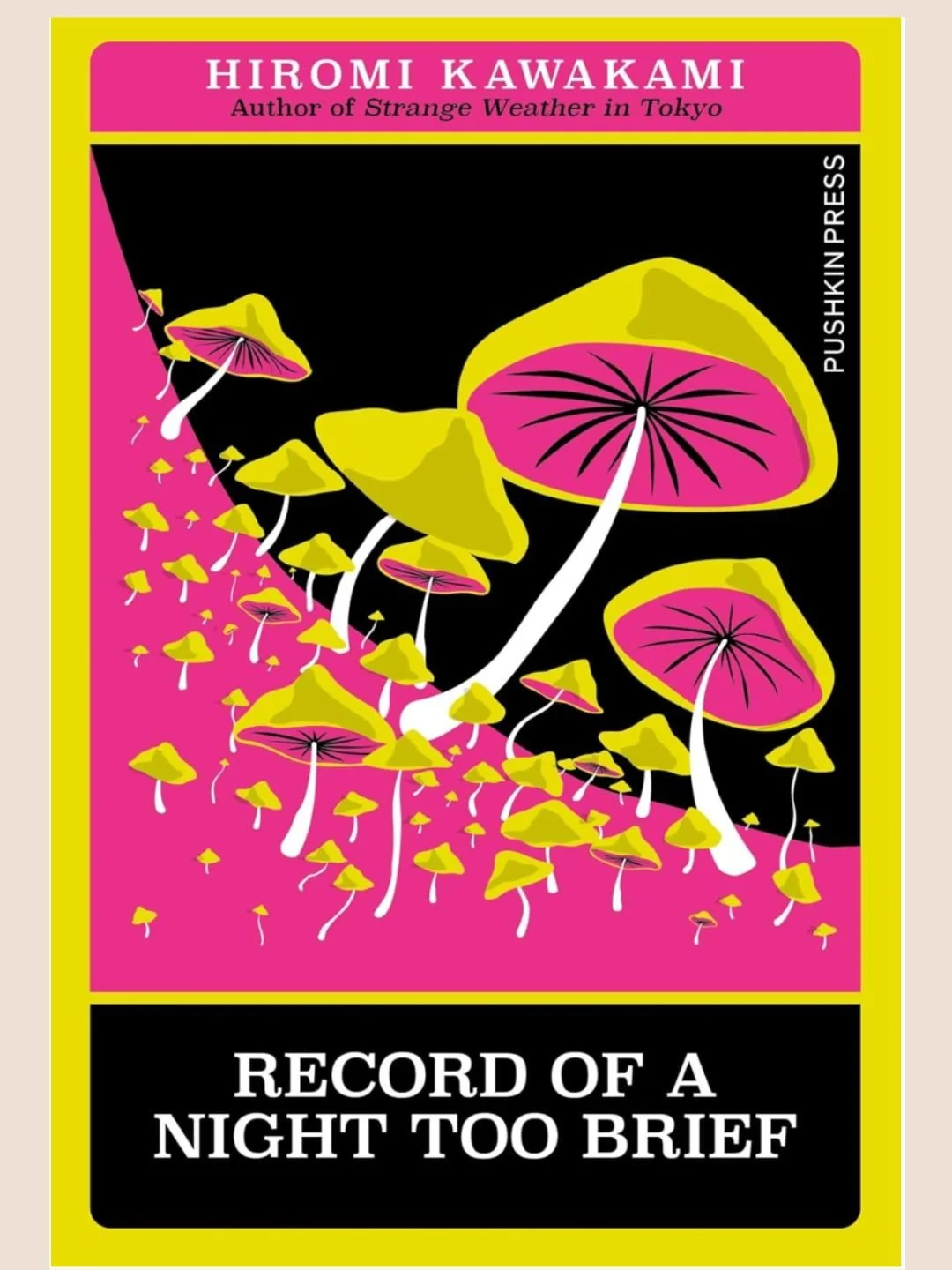
Record of a Night Too Brief
by Hiromi Kawakami
translated by Lucy North
This post contains affiliate links. If you make a purchase through one of these links, I may earn a small commission at no extra cost to you.
I walked into Record of a Night Too Brief completely blind, which turned out to be both a mistake and exactly right.
The book splits into three sections, and the opening title story is actually 19 short vignettes. I spent the first several assuming they'd eventually click into one continuous story. They don't. They're more like different dreams inside the same night, some linked by a narrator or a voice, others just showing up as their own strange little world. Transformations, creatures, things shifting shape mid-scene before you've even processed what you were looking at.
Once I stopped waiting for it to act like a normal book, it became something else entirely. Beautiful, honestly.
There's a line in "Apoptosis" that captures it exactly: "it felt as if I was going to remember it any moment now." That's the whole title sequence in one sentence. The images are unfamiliar but somehow feel almost known, the way dreams let something impossible feel completely reasonable while it's happening to you. One scene with a lion, a girl, and an entire lifetime passing between them got me in a way I still can't fully explain. That was the pattern with this collection: I didn't always understand the stories intellectually, but I understood exactly what they were doing to me emotionally.
The second section, "Missing," follows a family whose members occasionally just vanish. This time it's the eldest son, right as he's about to get engaged, told through his younger sister's eyes while everyone else carries on with this bizarre, practiced calm. It's sadder underneath than the surface lets on, but also genuinely funny, the family treats the impossible so matter-of-factly that the humor and the grief end up right next to each other. Still surreal, but "Missing" reads more like a family story than the dream-logic of the opening section.
Then there's "A Snake Stepped On," maybe the strangest of the three. Snake-like beings enter these characters' homes and lives and start taking on human roles, including motherhood, until the line between an ordinary human life and the world of the snakes basically disappears. I kept trying to pin down what the snakes symbolized: family obligation, motherhood, identity, the parts of ourselves we keep buried. Every time I thought I had it, the story wriggled out from under the theory. Eventually I just let it go. That might be the right approach to this whole collection: experience it, don't decode it. Kawakami's imagination and atmosphere are doing the work.
Lucy North's translation deserves real credit too. A collection this surreal could easily tip into confusing on the sentence level, but the prose stays clear and readable throughout, letting the strange images stay vivid without the language getting in the way.
If you like surrealism and dream logic, and don't need every image explained to enjoy it, this one's for you. It confused me at first. By the end I found it imaginative, atmospheric, and unexpectedly moving.
Worth the read.
I received a gifted copy of this book from Pushkin Press. All opinions are my own.
Where to Purchase
If you like this you may also like:
Under the Eye of the Big Bird by Hiromi Kawakami, translated by Asa Yoneda — her most recent work in English, shortlisted for the 2025 International Booker Prize; a fragmented, speculative vision of a post-collapse world with the same atmospheric, non-linear pull.
The Memory Police by Yōko Ogawa, translated by Stephen Snyder — objects and memories vanish from an island one by one, and everyone accepts it with the same eerie, unquestioning calm as the families in "Missing."
