
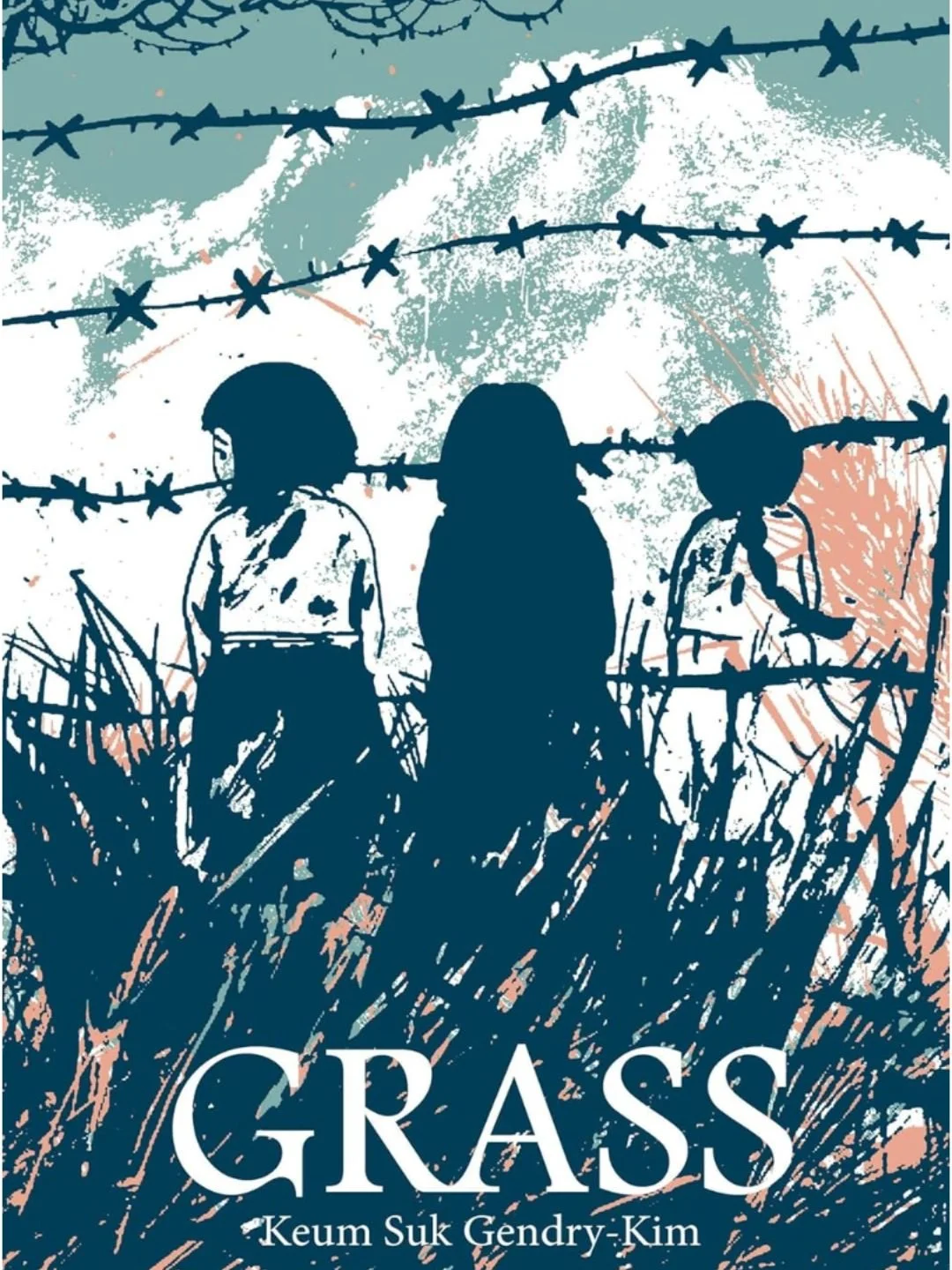
Grass
by Keum Suk Gendry-Kim
translated by Janet Hong
This post contains affiliate links. If you purchase through them, I may earn a small commission at no extra cost to you. All opinions are my own.
I'll be honest, I don't read a lot of manhwa or manga. This is actually the first one I've reviewed here, and it was voted one of our MAE Book Club picks of the month. It's about "comfort women," the hundreds of thousands of girls and women forced into sexual slavery by the Japanese military during World War II. This is history I feel strongly about, and I never want it forgotten.
Grass tells the story of Lee Ok-seon, known to many as Granny Lee. Keum Suk Gendry-Kim wrote it based on years of interviews with her. The book follows her from a little girl in a poor family, through the day she was taken, through the years of horror that followed, into her long life as a survivor and an outspoken advocate.
Because I don't read a lot of manhwa, I don't know if they're all this hard hitting, but the way the artist used black throughout reinforces the heaviness, the sadness, the horror of what Lee lived through and the reality of that time. I don't say this lightly: Grass is heartbreaking. I put it down in tears more than once. But it's also an important way to get this story in front of readers who might not otherwise be exposed to it.
Janet Hong's translation carries Lee's voice with the restraint and weight it deserves.
Definitely worth the read.
Where to Purchase
From My Notes
Grass is about a real person and a history that deserves the full context, so I'm including more of the background than I normally would in a review.
Who Was Lee Ok-seon
Lee Ok-seon was born in Busan and taken at fourteen years old to frontline brothels run by the Japanese military, where she was held for three years until the war ended. She spent decades of her life afterward in China before eventually returning to Korea.
She didn't speak publicly about what happened to her until she was in her seventies. Once she did, she didn't stop. She testified at Brown University in 2002, toured twelve cities across the US, Germany, and Japan in 2013, and traveled to China to give testimony again at age ninety. She lived for years at the House of Sharing, a home for former comfort women outside Seoul, and spent much of her later life pushing for an official apology and redress from the Japanese government, including publicly opposing agreements between the Korean and Japanese governments that she felt failed survivors.
Lee was also the real-life model for the Statue of Peace in Gwangju, one of the many comfort women memorial statues that have been installed around the world, including a replica in Glendale, California, that Lee herself traveled to defend when it faced a legal challenge.
Lee Ok-seon passed away on May 11, 2025, at the age of ninety-seven. At the time of her death, only six of the 240 comfort women officially registered with the South Korean government were still living.
Why August 14th Matters
August 14th is the International Memorial Day for Comfort Women. It was established in 2012 to mark the anniversary of August 14, 1991, the day Kim Hak-soon became the first survivor to publicly testify about what had happened to her, breaking a silence that had lasted decades. South Korea formally designated it a national memorial day in 2018.
Every year on this day, survivors, activists, and communities around the world hold memorials and demand continued acknowledgment of this history. With so few survivors left to tell their own stories, books like Grass matter more than ever.
More Books to Read on Comfort Women
Honey in the Wound by Jiyoung Han - a multigenerational family saga blending magical realism with the story of a comfort woman survivor and her descendants
White Chrysanthemum by Mary Lynn Bracht - historical fiction following two Korean sisters on Jeju Island, one taken as a comfort woman, told across dual timelines
One Left by Kim Soom, translated by Bruce and Ju-Chan Fulton - the first Korean novel devoted entirely to a comfort woman's perspective, built from survivor testimony
8 Lives of a Century-Old Trickster by Mirinae Lee - a woman's life told in eight interconnected stories, one of them her time as a comfort woman in a Japanese-run brothel in Indonesia. Also available from Bookoutlet.com
Can't I Go Instead by Lee Geum-yi, translated by An Seonjae - two women's fates get swapped, and one is sent to become a comfort woman in her mistress's place (on my TBR)
