
Where to Start with Asian Women in Translation: 12 Books Written and Translated by Women
This post may contain affiliate links. If you purchase through one of these links, I may earn a small commission at no additional cost to you.
August is Women in Translation Month. I read women in translation all year, not just in August. So this year, instead of only spotlighting women authors in translation, which many accounts already do well, I decided to spotlight the women who translate them too. Every book in this guide was written by an Asian woman and translated into English by a woman.
Once I made that choice, the next question was obvious: where do you actually start?
Asian literature isn't one genre. It includes quiet character studies, psychological suspense, graphic nonfiction, satire, speculative fiction, healing literature, historical fiction and much more. That is a lot, so instead of sorting these books by country, I organized them by the kind of reading experience you're already drawn to.
Over the past 18 months, I've read close to 200 books by Asian authors. I'll be upfront that my reading is strongest in East Asian literature, especially books from Korea and Japan, so this guide isn't trying to represent an entire continent. Every book here is one I've actually read, and every translator is named because that's non-negotiable for me.
Before You Choose a Book
Unfamiliar doesn't mean inaccessible
Different naming conventions, historical references or narrative structures might slow you down at first. That doesn't mean the book is too hard for you. You're simply meeting a form that wasn't built around your usual expectations, and that can be worth pushing through.
Short doesn't always mean light
Several of these books are under 250 pages, but some are much heavier than their page counts suggest. A short book can hit harder than a much longer one.
One book can't represent a country
A novel can open a door, but it can't explain an entire culture on its own. Let one book lead you to another writer, another translator or another period rather than asking it to speak for millions of people.
1. You Want Something Quiet and Introspective
Strange Weather in Tokyo by Hiromi Kawakami, translated by Allison Markin Powell
Tsukiko, a woman in her late thirties, reconnects with her former teacher at a neighborhood bar. Their relationship builds slowly through shared meals, drinks, seasonal outings and a lot of ordinary life.
There's a lot of feeling packed into how quiet it is. This is a book about loneliness, aging and the distance that can remain between two people who still care about each other. The small details are what make it work: the food, the weather, the awkward pauses and the slow realization that something between them has shifted.
Start here if: you want a slow burn with subtle relationships, food, seasons and melancholy that never becomes overwhelming.
Record of a Night Too Brief by Hiromi Kawakami, translated by Lucy North
These three stories move through dreams, loss, desire and transformation. One woman travels through an apparently endless night with a porcelain companion, another mourns a brother only she can still see, and an encounter with a snake opens a hidden world.
The stories are strange and dreamlike, but the emotions underneath remain recognizable. They are less concerned with realism than with the way grief, memory and desire can reshape the world around us.
Start here if: short fiction and surreal imagery are your thing, and you don't mind a story that feels closer to a dream than a traditional plot.
Choose between them: Pick Strange Weather in Tokyo for warmth and companionship. Pick Record of a Night Too Brieffor something stranger and more dreamlike.
2. You Like Quirky or Unsettling Books
Convenience Store Woman by Sayaka Murata, translated by Ginny Tapley Takemori
Keiko has worked at the same convenience store for eighteen years. The store's rules and routines make sense to her in a way society's expectations never have. Everyone around her thinks she should want a respectable job, a relationship and a conventional adult life. Keiko isn't convinced.
For someone new to contemporary Japanese fiction, this is one of the easiest places to begin. It's short, funny, strange and sharper than the premise first suggests. Underneath the humor is a real question about who gets to decide what a normal life looks like.
Start here if: you like social satire and unconventional women, and you want something odd that's still easy to follow.
The Hole by Hye-young Pyun, translated by Sora Kim-Russell
Oghi wakes after a car accident to discover that his wife has died and he has been left paralyzed. He becomes entirely dependent on his mother-in-law, who is grieving her daughter and beginning to look at Oghi's marriage very differently.
This book is claustrophobic. It gave me the trapped, powerless feeling I got from Misery, but with a quieter and more psychologically controlled kind of dread. The tension comes from what Oghi can't do, what he can't say and what may have happened before the accident.
Start here if: you're here for psychological suspense, an unreliable perspective and tension that builds without a lot of action.
Choose between them: Pick Convenience Store Woman for strange and funny. Pick The Hole for strange and frightening.
3. You Want History, Memory and Testimony
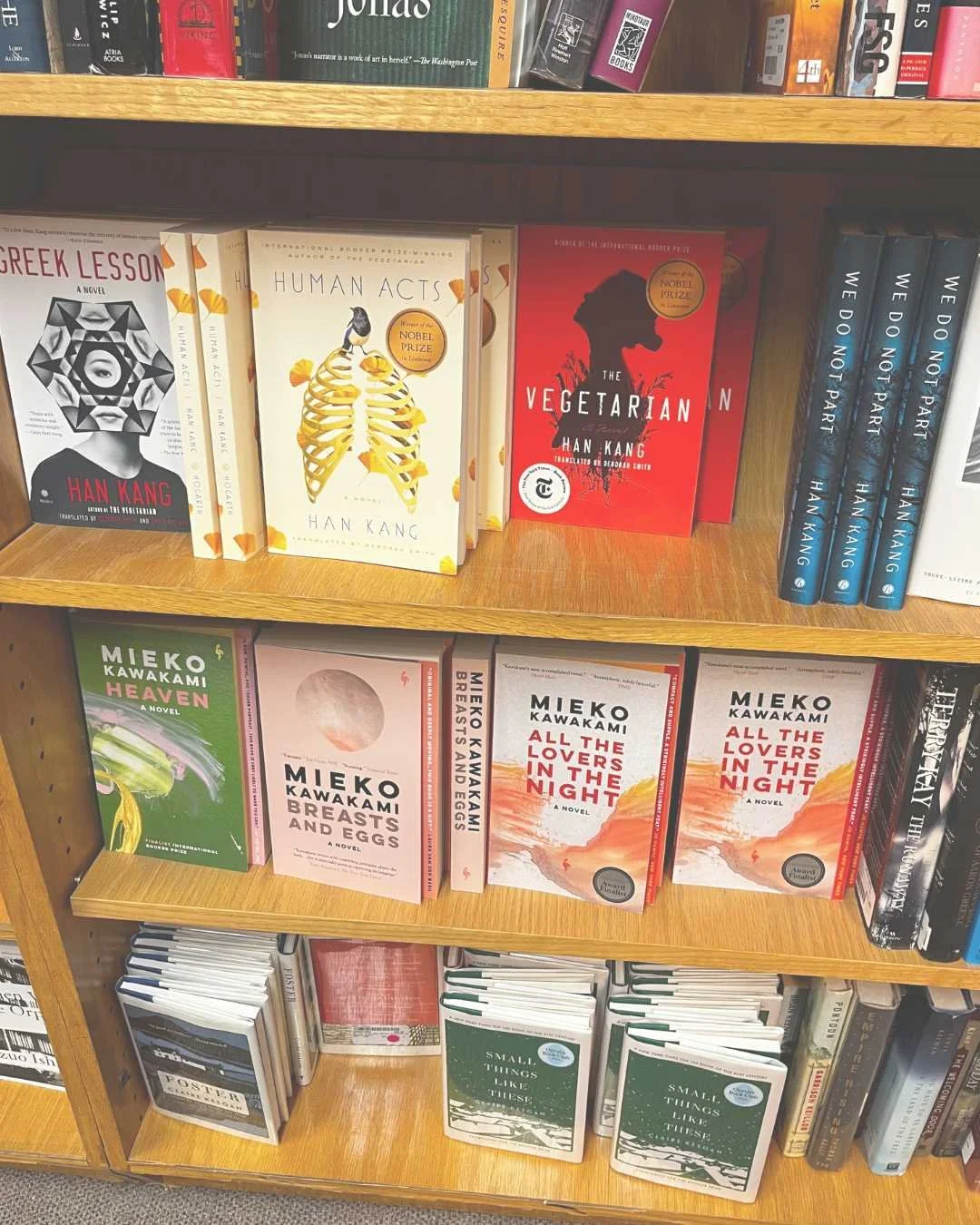
Human Acts by Han Kang, translated by Deborah Smith
Set during and after the 1980 Gwangju Uprising, the novel follows several people whose lives are changed by the violence, including a young boy searching for his friend, grieving families, prisoners and survivors who carry the events into adulthood.
The novel shifts between voices, but the history never feels distant. It doesn't soften the brutality, and it refuses to reduce the people at the center of the novel to victims or statistics. What it is really asking is how political violence goes on living inside bodies, families and collective memory long after the event itself.
Content note: graphic violence, torture, death and grief.
Start here if: you're ready for an emotionally intense historical novel that doesn't look away from violence or its aftermath.
Grass by Keum Suk Gendry-Kim, translated by Janet Hong
This graphic nonfiction book is based on interviews with Lee Ok-sun, a Korean woman who was forced into sexual slavery by the Japanese military during World War II. The black-and-white art gives space to testimony, silence and the parts of trauma that can't be smoothed over for the reader.
This one isn't easy. Image, oral history and personal testimony together make the subject feel immediate without sensationalizing it. The book also shows just how long trauma lives on through poverty, displacement and the struggle to be heard decades later.
Content note: sexual violence, war, child abuse and trauma.
Start here if: graphic nonfiction, oral history or books about memory and historical erasure pull you in.
Choose between them: Pick Human Acts for a direct and emotionally intense historical novel. Pick Grass for testimony told through graphic nonfiction.
4. You Want Something Short, Direct and Highly Discussable
Kim Jiyoung, Born 1982 by Cho Nam-joo, translated by Jamie Chang
Kim Jiyoung's life is told in a plain, almost clinical style that traces the sexism she encounters at home, at school, at work and after becoming a mother. Footnotes and real-world data give parts of the novel the feel of a case file.
It's short, direct and built to start conversations. You don't need prior knowledge of Korean society to understand its central argument, although the details might send you looking for more once you're done.
Start here if: you want fiction that makes a clear social argument about gender, work and motherhood.
Concerning My Daughter by Kim Hye-jin, translated by Jamie Chang
An aging mother lets her adult daughter, Green, move back home, but struggles to accept Green's long-term relationship with another woman. At the same time, her work caring for an elderly woman with dementia forces her to confront her own ideas about family, responsibility and whose lives society considers valuable.
It's short, and it's the kind of book you'll want to talk to someone about because it never makes the mother easy to like or easy to write off. Her prejudices are central to the story, but so are her fears about aging, poverty and what happens when no one is left to look after her.
Start here if: complicated family relationships and morally uncomfortable narrators are your kind of read.
Choose between them: Pick Kim Jiyoung, Born 1982 for broad, direct social commentary. Pick Concerning My Daughter for a more intimate conflict rooted in family, care and prejudice.
5. You Want Healing Literature
Healing fiction has become especially visible in English-language publishing in recent years, with many popular translations arriving from Japan and South Korea. These novels often follow people burned out by work, competition or city life who step into a quieter space, such as a bookshop, café or studio, and begin rebuilding through routine and community.
The covers may look cozy, but the better books aren't pretending that a warm drink or a creative hobby can erase a crisis. The setting gives the characters room to pause, but they still have to do the internal work of changing their lives.
Soyangri Book Kitchen by Kim Jee Hye, translated by Shanna Tan
Yoojin leaves the pressure of Seoul behind and opens a bookshop café with an overnight bookstay in a quiet village. Over the course of a year, people arrive at turning points in their own lives and find space there for books, food, rest and honest conversation.
It's soft and comforting without ever being simplistic. Yoojin is quietly strong and grounded, and the Book Kitchen doesn't solve everyone's problems for them. It gives people room to stop, think and figure out what they actually want next.
Start here if: you like bookshops, food, rural settings and found community, with healing stories that still have real problems underneath them.
The Healing Season of Pottery by Yeon Somin, translated by Clare Richards
After burning out in her television writing job, Jungmin abruptly quits and pulls away from the world. When she finally starts leaving her apartment again, she finds a neighborhood pottery studio, and the clay, coffee, food and people around the worktable slowly bring her back to herself.
I found this lovely and tender, the kind of book that's soothing without being sappy. The healing happens through working with her hands, letting the seasons pass, making friends and accepting that starting over doesn't happen all at once.
Start here if: burnout, creative hobbies and gentle community are what you're after. This is about rebuilding a life one small routine at a time.
Choose between them: Pick Soyangri Book Kitchen for books, food and several people finding their way forward together. Pick The Healing Season of Pottery for one woman's quieter recovery through art, friendship and starting over.
6. You Like Speculative or Idea-Driven Fiction
The Emissary by Yoko Tawada, translated by Margaret Mitsutani
After a massive disaster, Japan cuts itself off from the world. Children are born frail, while the elderly remain vigorous and seem unable to die. Yoshiro spends his days caring for his great-grandson Mumei, a boy who can barely stand but meets his strange existence with curiosity rather than despair.
Tawada builds an unsettling premise around the old outliving the young, then tells it with a lightness and dry humor that keep sneaking up on you. The novel is less interested in explaining its world than in letting you sit inside its logic, and there is real tenderness in the way Yoshiro cares for Mumei alongside all the strangeness.
Start here if: you want speculative fiction that's melancholy and strange rather than relentlessly dark, with big ideas about aging, language and what gets carried forward when everything else falls apart.
A Plagued Sea by Kim Bo-Young, translated by Sophie Bowman
Bodyguard Mu-young is waiting for a train to the isolated seaside village of Haewon when an earthquake warning appears. Despite the danger, she boards with her niece rather than leave the girl behind. Three years later, the earthquake has unleashed an ancient plague that is slowly transforming the villagers into something between human and fish, while a government lockdown has cut the village off from help.
Kim draws on the coastal horror of Lovecraft's The Shadow Over Innsmouth, moving it into a Korean setting and giving the story a very human center. It works as cosmic horror and as a grief story about guilt, guardianship and how much one person can carry for someone else's child. I read this as an advance copy, and that guardianship thread is the part I keep coming back to.
Content note: body horror, death and grief.
Start here if: you want your idea-driven fiction with teeth. This is cosmic horror and disaster fiction that takes its emotional weight as seriously as its monsters.
Choose between them: Pick A Plagued Sea for cosmic horror with a lot of heart. Pick The Emissary for a gentler, stranger kind of dystopia.
Still Not Sure? Start Here
Easiest overall entry point: Convenience Store Woman.
Something quiet and beautiful: Strange Weather in Tokyo.
History and memory: Human Acts.
Graphic nonfiction: Grass.
Dark and tense: The Hole.
Healing literature: The Healing Season of Pottery.
Short, direct social commentary: Kim Jiyoung, Born 1982.
Speculative and strange: The Emissary.
Your First Book Doesn't Need to Be the Most Important One
There's no correct first book by an Asian woman in translation. You don't need to start with the most famous author, the most historically important title or the book that appears on every list.
Your first pick only needs to make you curious enough to reach for another one.
Start with what you already love, then pay attention to the writer, the translator, the original language and the publisher who brought the book into English. Let each book open a door to another voice instead of turning the month into homework.
Already interested in Korean literature? Continue with 25 Korean Books to Start With.
