
Light and Thread
by Han Kang
Translated by Maya West, e. yaewon & Paige Aniyah Morris
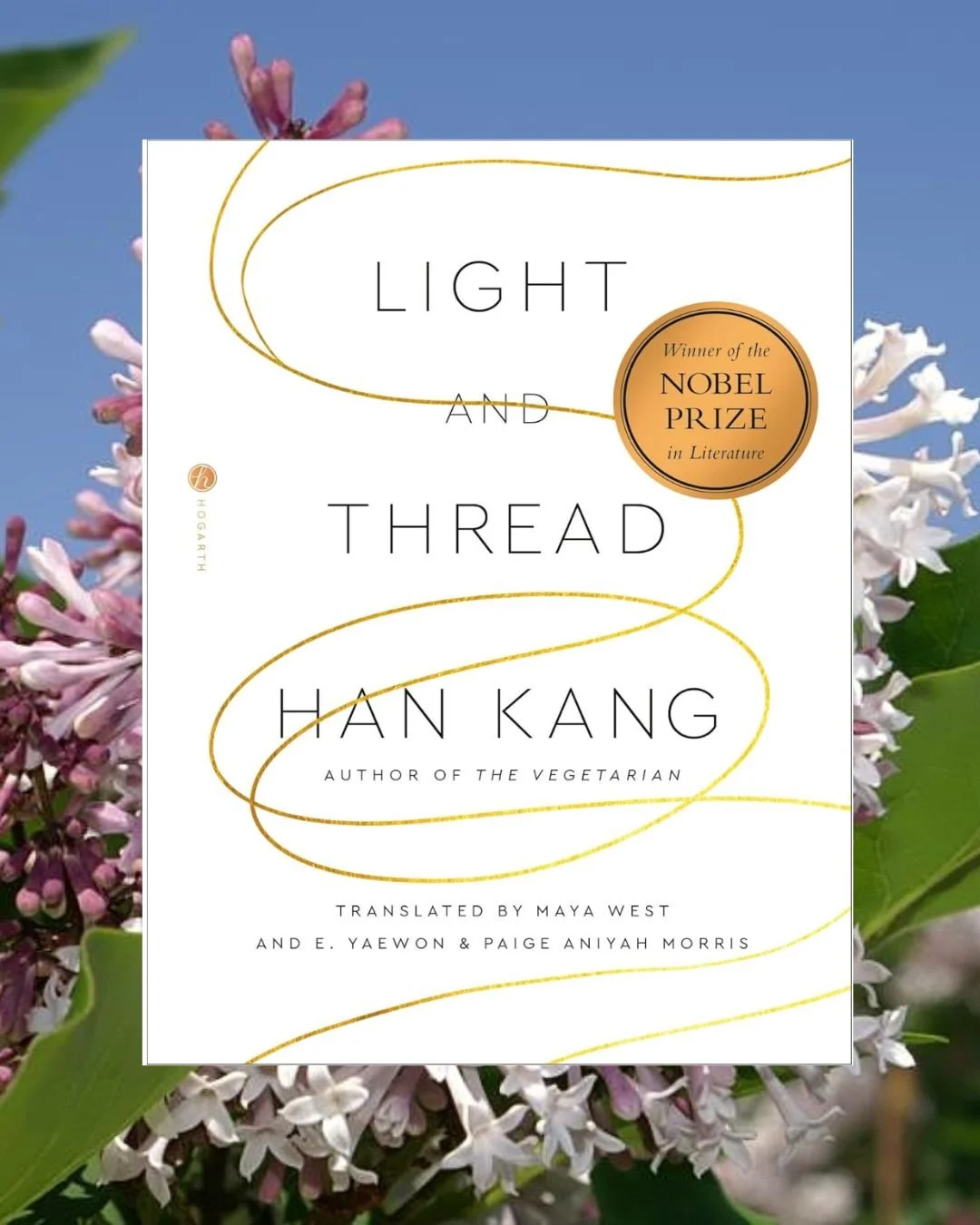
Where to Purchase: Bookshop.org | Amazon
Review
Published March 24, 2026 | Hogarth Press
What It's About
When Han Kang accepted the Nobel Prize in Literature in December 2024, becoming the first Korean writer and the first Asian woman to receive it, she named her lecture Light and Thread. Such a humble title for the biggest moment of a writer's career. Something small and quiet, true to who she is. She writes about ordinary people, small details, a garden, a teacup.
Light and Thread is Han Kang's first work of nonfiction published in English. It gathers essays, poems, diary entries, and photographs into something that feels less like a book and more like an extended meditation on what it means to write at all, and why she keeps doing it even when the material breaks her.
What I Loved
She talks about her process. The years she spent writing We Do Not Part, a novel built around the 1948 Jeju massacre, one of the darkest chapters of Korean history, and how the weight of that research almost undid her. She had to hold all of that suffering in her body while she worked. Even the smallest details mattered. She went out to test the snow. She tracked where the shadows fell. That is the kind of writer she is.
But then there is the garden.
At the center of this book is Han Kang's small north-facing courtyard, a garden that receives almost no direct sunlight. To grow anything at all, she moves mirrors throughout the day, following the arc of the sun, redirecting what light she can toward the plants. Her garden diary is woven through this collection, and I loved it. It also gave me something I did not expect: a window into her mind. The same quality of attention she brings to the most devastating chapters of Korean history, she brings to a patch of winter light on a wall. That is who she is as a writer.
It made me think about my own garden, and my own stubborn project of trying to grow things in conditions that were never quite right for them. I wonder if a Miss Kim Lilac will grow in the hot Southern California sun. It made her more human to me. More real. She made me feel like I should be writing all my experience battling my garden down. Like they were worthy too.
There is a poem she wrote at eight years old, something about a gold thread of connection, and she follows that thread through this entire book. Between writer and reader. Between the living and the dead. Between darkness and whatever light we can manage to angle in.
Some of her poems are here. Along with a few of her photographs. All of it confirms what her novels have always suggested: that she is someone whose talent overflows every container she puts it in. Even her garden journal reads like poetry.
If you are someone who has read her work and want to get a glimpse of who she is as a person this book is for you. If you are looking to get started in reading her writing I would recommend you start with one of her other pieces.
If you want to understand what the Nobel committee meant, read Human Acts. It is not the easiest entry point but it is the fullest expression of what she does, and the historical context of the Gwangju Uprising is something your reading life should include.
If you want to begin with something shorter and more contained, The Vegetarian is where most Western readers started.
If you want to start with what she is doing right now, We Do Not Part is her most recent novel.
Just start. The order matters less than you think.
This is a slim book. She has spent her whole career holding the weight of history, and this is the book where you get to see how she carries it day to day. Some readers expecting a full memoir may feel it ends too soon. And I understand that. But what is here is so rare that I would rather have this than twice the pages of something lesser. It feels like a gift.
Thank you Hogarth | Random House for the eARC.
Where to Purchase
Bookshop.org | Amazon
If you liked this
Amy Tan's The Backyard Bird Chronicles covers similar ground. A celebrated novelist turns her attention to something small and daily, and the result is unexpectedly profound.
