
25 Korean Books to Start With
This post may contain affiliate links. If you purchase through one of these links, I may earn a small commission at no additional cost to you.
Korean literature is not one thing. Some books feel sharp and political. Others stay close to home and settle into your chest in quiet ways that take days to shake off.
This list brings together 25 titles that I think work well for anyone looking for a place to start. Some are well known. Others feel smaller and more intimate. Together, they show different parts of what Korean writing can do.
I am using Korean literature broadly here. The list includes books translated from Korean as well as books by Korean and Korean diaspora writers working in English. For every translated book, I have named the translator.
One small notebefore you get started, I wanted to share a small hack that helps me save money on the books I have shared here. I run every order through Rakuten first so a percentage comes back. It's free, it takes two minutes, and I've gotten about $500 back since 2022. Here's how I set it up.
Browse All 25 Books
I gathered every title from this guide into one list so you can browse the complete collection in one place.
Essential Starting Points.
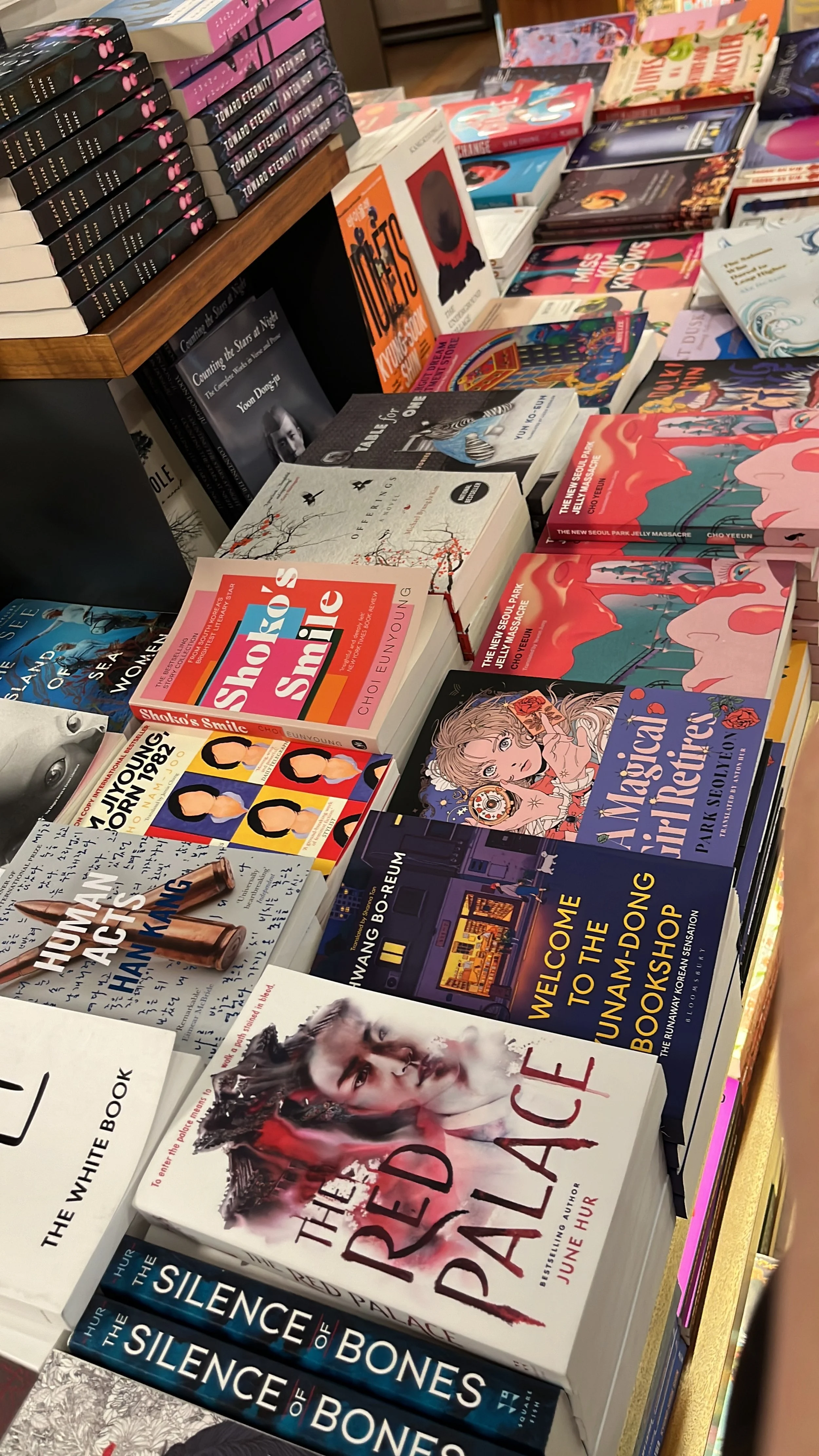
1. Kim Jiyoung, Born 1982 by Cho Nam-joo, translated by Jamie Chang
Kim Jiyoung’s life is told in a plain, almost clinical style that traces the sexism she encounters at home, at school, at work and after becoming a mother. Footnotes and real-world data give parts of the novel the feeling of a case file.
It is short, direct and built to start conversations about gender, work, family and the expectations placed on women.
Read my review
2. Please Look After Mom by Kyung-sook Shin, translated by Chi-Young Kim
When a mother disappears in a crowded Seoul subway station, her family begins searching for her. As the story moves between their perspectives, they are forced to confront how little they understood about the woman who held their lives together.
This is a quietly devastating book about motherhood, memory, regret and the people we fail to see clearly until they are gone.
Read my review
3. The Vegetarian by Han Kang, translated by Deborah Smith
A woman’s decision to stop eating meat disrupts the fragile structure of her marriage and family. Her refusal becomes something other people try to interpret, control and punish.
This is not really a novel about food. It is an unsettling story about bodily autonomy, silence, rebellion and what happens when a woman refuses to keep living according to everyone else’s expectations.
Read my review
4. Human Acts by Han Kang, translated by Deborah Smith
Set during and after the 1980 Gwangju Uprising, Human Acts follows a young boy, grieving families, prisoners and survivors whose lives are permanently changed by state violence.
The novel moves between voices and across time, showing how political violence continues to live inside bodies, families and collective memory long after the event itself.
Read my review
5. I Want to Die but I Want to Eat Tteokbokki by Baek Sehee, translated by Anton Hur
This unconventional memoir is built from therapy transcripts and the author’s reflections on depression, self-worth, relationships and the contradictions inside her own thinking.
The format can feel repetitive, but that repetition is also part of what the book captures. Recovery does not move in a straight line, and insight does not always arrive at the moment we want it to.
Read my review
6. Welcome to the Hyunam-dong Bookshop by Hwang Bo-reum, translated by Shanna Tan
After reaching a breaking point, Yeongju leaves her old life behind and opens a neighborhood bookshop. The shop slowly becomes a refuge for people who are also trying to reconsider work, relationships and what a meaningful life might look like.
This is a gentle healing novel about books, burnout, routine and rebuilding at your own pace.
7. Lemon by Kwon Yeo-sun, translated by Janet Hong
Years after a teenage girl is murdered, several women continue to circle the case, each carrying a different version of grief, guilt, memory and truth.
This is not a conventional mystery built around solving a crime. It is more interested in what violence leaves behind and how the people connected to it continue living when no answer can make them whole.
8. Concerning My Daughter by Kim Hye-jin, translated by Jamie Chang
An aging mother allows her adult daughter, Green, to move back home but struggles to accept Green’s long-term relationship with another woman.
At the same time, her work caring for an elderly woman with dementia forces her to confront her beliefs about family, responsibility, aging and whose lives society considers valuable.
Read my review
9. Blowfish by Kyung-Ran Jo, translated by Chi-Young Kim
A sculptor and an architect, each living close to suicide and grief, cross paths in Seoul and later meet again in Tokyo. Their connection moves through art, death and the possibility that another person might briefly interrupt a decision that feels final.
This is a slow, contemplative novel that asks the reader to sit with discomfort rather than rush toward resolution.
Read my review
10. At Dusk by Hwang Sok-yong, translated by Sora Kim-Russell
A successful architect receives a message from someone connected to his past just as his present life begins to come apart.
As he looks back at the poverty, friendships and ambitions he left behind, the novel traces South Korea’s rapid developmentand asks what progress costs the people and places pushed aside to make room for it.
Read my full review of At Dusk.
11. Almond by Sohn Won-pyung, translated by Sandy Joosun Lee
Yunjae was born with a condition that makes it difficult for him to identify and express emotion. After violence changes his life, an unlikely friendship with an angry and unpredictable boy begins to challenge what Yunjae understands about fear, grief, connection and love.
This is an accessible coming-of-age novel with a strong emotional center.
12. Love in the Big City by Sang Young Park, translated by Anton Hur
Young moves through friendship, hookups, illness, grief and heartbreak in Seoul while trying to build a life that does not fit neatly into anyone else’s expectations.
The novel is funny, messy, sharp and deeply vulnerable. Its fragmented structure mirrors the way memory works, especially when love and loss have become difficult to separate.
Read my review
Speculative, Strange and Edge-Lit
13. Cursed Bunny by Bora Chung, translated by Anton Hur
These stories move between horror, folklore, science fiction, satire and body horror without settling comfortably into any one genre.
Cursed objects, vengeful spirits and grotesque transformations expose the violence sitting beneath capitalism, misogyny, family systems and ordinary life. It is imaginative, disturbing and relentlessly smart.
Read my review
14. Your Utopia by Bora Chung, translated by Anton Hur
These speculative stories explore technology, bodies, artificial intelligence, survival and the uneasy bargains people make when the world around them has already started to lose its humanity.
The collection is cooler and more restrained than Cursed Bunny, but it carries the same interest in power, isolation and the systems people accept as normal.
15. Walking Practice by Dolki Min, translated by Victoria Caudle
A shapeshifting alien stranded on Earth uses dating apps to lure and eat humans while trying to navigate the limits of its body under Earth’s gravity.
Underneath the grotesque premise is a sharp story about gender, queerness, hunger, alienation and the violence of being treated as either a curiosity or a threat.
Read my review
16. The Disaster Tourist by Yun Ko-eun, translated by Lizzie Buehler
Yona works for a travel company that packages disaster zones as tourist experiences. After reporting harassment at work, she is sent to evaluate an unpopular destination and becomes trapped inside a corporate plan to manufacture the kind of catastrophe tourists are willing to pay to see.
It is a sharp satire about exploitation, workplace power and what happens when suffering becomes a product.
17. Counterweight by Djuna, translated by Anton Hur
On the fictional island of Patusan, a Korean conglomerate is building the world’s first space elevator while local resistance groups push back against the company’s growing control.
Cybernetic implants, false identities, corporate espionage and a fight over the island’s future turn the novel into a fast-moving cyberpunk thriller with real weight beneath the action.
Short Story Collections
18. Flowers of Mold by Ha Seong-nan, translated by Janet Hong
These stories begin in recognizable domestic spaces and slowly tilt toward obsession, violence, dread and emotional disconnection.
Ha Seong-nan has a way of making ordinary life feel unstable without announcing exactly when the shift occurred. By the time something feels wrong, you are already inside it.
19. Shoko’s Smile by Choi Eunyoung, translated by Sung Ryu
These stories look closely at friendship, family, grief, political history and the quiet damage caused by distance and misunderstanding.
The emotions are restrained rather than dramatic, but they linger. Choi is especially good at showing the moments people remember years later because they finally understand what they could not see at the time.
Thrillers and Page-Turners
20. The Plotters by Un-su Kim, translated by Sora Kim-Russell
Reseng is an assassin raised inside a library by the man who runs him. When he begins questioning the hidden system that assigns deaths and disposes of killers, he is pulled into a violent struggle over who controls the business of murder.
It is dark, strange and unexpectedly funny, with a world of assassins, conspiracies and bureaucratic violence operating just beneath ordinary Seoul.
21. The Hole by Hye-young Pyun, translated by Sora Kim-Russell
Oghi wakes after a car accident to discover that his wife has died and he has been left almost completely paralyzed.
He becomes dependent on his grieving mother-in-law, who is beginning to look at his marriage differently. Trapped inside his own body and unable to explain himself, Oghi slowly loses control over his home, his story and whatever may be happening in the garden outside.
Read my review
Korean-American and Diaspora Written in English
22. If I Had Your Face by Frances Cha
Four young women living in Seoul navigate beauty standards, economic pressure, work, relationships and limited choices.
The novel looks closely at the way beauty can become a form of currency, especially for women who have been given very little room to move. It is raw and bleak in places, but it never treats its characters as spectacles.
23. Pachinko by Min Jin Lee
This multigenerational novel follows a Korean family from Japanese-occupied Korea to Japan, where each generation faces discrimination, poverty, sacrifice and the complicated work of building a life in a country that may never fully accept them.
It is a family story, but it is also an accessible way into the history of Koreans in Japan and the long consequences of colonialism.
24. Skinship by Yoon Choi
These stories follow Korean American families across generations, languages and the silences that hold both love and loss.
The collection pays attention to small moments: a child watching a parent, an aging relative carrying an old grief, or two people who love each other but do not know how to say what they mean.
Read my review
25. Crying in H Mart by Michelle Zauner
Michelle Zauner’s memoir explores the loss of her mother, her Korean American identity and the way food becomes both memory and a path back toward the person she has lost.
It is a grief memoir, but it is also about language, family, inheritance and how cooking can hold parts of a relationship that are otherwise impossible to recover.
Read my review
Ready to Choose Your First Book?
Browse all 25 titles together on my Bookshop.org list, from quiet literary fiction and healing books to horror, thrillers and speculative fiction.
Looking for an even broader place to begin? I also created a guide to 12 books by Asian women in translation, organized by the kind of reading experience you already enjoy, from quiet fiction and healing literature to history, psychological suspense and speculative fiction. Every book was written by an Asian woman and translated into English by a woman.
Read: Where to Start with Asian Women in Translation
Before you start ordering, I wanted to share a small hack that helps me save money on the books I have shared here. I run every order through Rakuten first so a percentage comes back. It's free, it takes two minutes, and I've gotten about $500 back since 2022. Here's how I set it up.
