
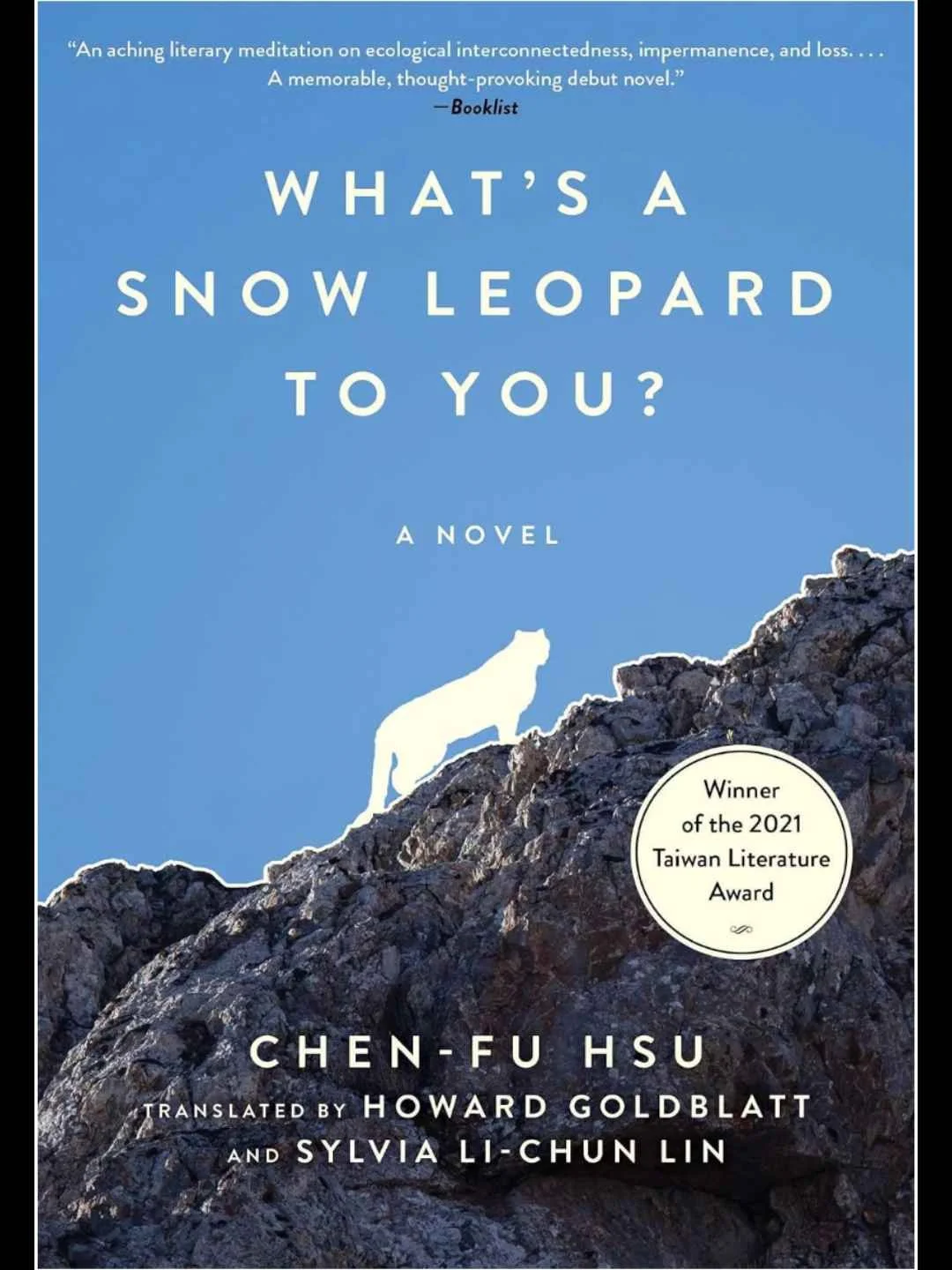
What’s a Snow Leopard to You?
by Chen-Fu Hsu
Translated by Howard Goldblatt and Sylvia Li-chun Lin
ARC Review
Arcade Publishing | September 22, 2026
What’s a Snow Leopard to You? is deliberately hybrid, intellectually curious and ambitious.
Chen-Fu Hsu begins with his own search for a snow leopard on the Tibetan Plateau, but the book quickly expands far beyond that search. The book brings together travel writing, fiction, Tibetan history, ecology, religion and personal reflection, with Hsu often following an observation wherever it takes him.
One moment I was following him across the plateau. The next I was inside the fictional story of two brothers who kill a snow leopard because their family desperately needs money. Elsewhere, the book moves through political upheaval in Tibet, cultural change, Buddhist thought and the complicated relationship between people and the land they depend on.
There is an enormous amount here, but I found myself most drawn to the moments when all of those ideas came back to an individual person or story.
Looking for Something You May Never Find
The snow leopard is almost always just out of reach.
From the beginning, Hsu is already questioning why seeing the animal matters so much when there are so many other ways to know it.
He finds tracks, hears stories and repeatedly arrives just before or after someone else has seen one. At one point, he learns that a snow leopard had been nearby watching while he completely missed it.
Eventually, the search begins to feel less like a hunt for an animal and more like a way of thinking about everything we try to understand but can never completely possess.
The title question works the same way. A snow leopard means something different depending on who is looking at it. It can represent scientific research, money, conservation, something sacred or simply something beautiful and almost impossible to see.
For Hsu, it becomes tangled up with memory, landscape and years of his own life.
The Human Stories
Some of my favorite sections were the ones that stayed closest to people.
The fictional story of the brothers Rinchenkha and Namkha especially worked for me. Their decision to kill a snow leopard is not treated as a simple question of right and wrong. Their father needs medical care, their family needs money, and conservation looks very different when viewed from the perspective of someone trying to survive.
I also enjoyed many of Hsu’s conversations along the way. A discussion about animals might become a conversation about religion, folklore or childhood, and those smaller encounters often gave me an entry point into the larger ideas he was exploring.
The other storylines widen that view. The Taming Sheep sections bring Tibet’s history and political upheaval into the book, while Pema, an aging Tibetan opera performer, brings cultural change down to the level of one person watching the world around his art change.
Pema’s story is heartbreaking because we see cultural change through someone who has spent his life inside the tradition that is disappearing around him.
That was where this book worked best for me. The ideas were always interesting, but I connected most when there was a person standing in the middle of them.
There were also moments when Hsu’s reflections reminded me of reading something like Siddhartha. Not because the books are particularly similar, but because Hsu can become deeply meditative about landscape, mortality, religion and his own search for meaning.
At other times, the book becomes much more research driven. That movement between the two is very much part of what this book is.
Howard Goldblatt and Sylvia Li-chun Lin’s Translation
Howard Goldblatt and Sylvia Li-chun Lin’s translation handles those shifts remarkably smoothly.
The language itself never made the book difficult to follow, and some of Hsu’s descriptions of the plateau, particularly the snow, animals and enormous quiet of the landscape, are beautiful.
Worth the Read
Hsu goes looking for a snow leopard and ends up writing about everything surrounding that search: people, animals, history, memory, loss and the different ways human beings try to understand the world around them.
There were sections I found genuinely compelling, conversations I loved and ideas that gave me plenty to think about. I connected most strongly when the book came back to people, but I can also see this being an even stronger read for someone who enjoys a more philosophical, wandering kind of reading experience.
Worth the read.
I received a gifted advance copy of What’s a Snow Leopard to You? from Arcade Publishing. Opinions are my own.
Where to Purchase
Bookshop.org | Amazon | Publisher
This post contains affiliate links. If you purchase through my links, I may earn a commission at no additional cost to you.
