
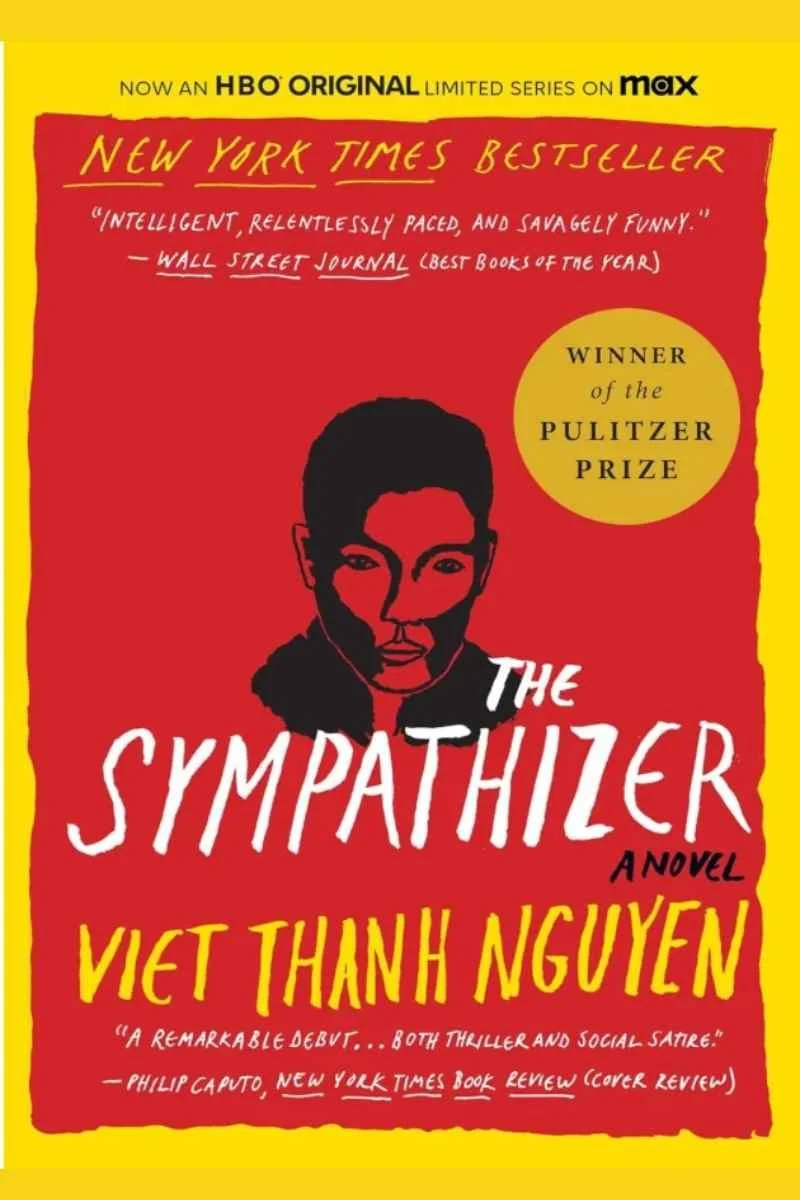
The Sympathizer
by Viet Thanh Nguyen
Grove Press, 2015
Content note: This novel includes war atrocities, torture, murder, sexual violence and rape. The sexual violence is especially difficult to read.
This was the October pick for the My Asian Era Book Club, and I finished it just in time. I loved The Sympathizer, but man, this was a hard book.
For most of it, I would have said I could recommend it to any serious reader. Then I reached a scene involving sexual violence that changed how freely I could say that. It was gut wrenching and honestly made me sick to my stomach.
That does not change how good I think the book is, but readers should know what they are walking into.
The unnamed narrator is a communist spy working inside the South Vietnamese military who escapes to the United States after the fall of Saigon. The novel is framed as his confession, and from the beginning you are inside the mind of someone who is constantly explaining, defending, judging and sometimes arguing with himself.
He is sharp, funny, ironic, political and very aware of the contradictions around him. As the book goes on, some of that certainty about himself starts to give way.
A Man of Two Minds
The narrator describes himself as a man of two minds, and that division runs through almost everything.
There is the obvious political split. He is a communist revolutionary while living among people who believe he is loyal to South Vietnam, but there are so many other divisions too.
He is of mixed Vietnamese and French parentage, bringing France's colonial history in Vietnam right into his own identity. Then there is America, another country that becomes part of his life and has its own complicated history with Vietnam. He moves between cultures, is both a spy and a friend, and believes in the revolution while also understanding and sometimes enjoying the world he is supposed to be working against.
He never seems completely at home anywhere.
The confession eventually reaches a point where what he has been willing to say is no longer enough.
I also kept coming back to Bon and Man, two of the men closest to him. On the page, Bon reads as the French word for “good,” while Man reads as the English “man.” I don't know if Nguyen intended the wordplay, but together they made me think of the good man the narrator believes himself to be.
So Sharp, So Smart
Nguyen's writing is phenomenal.
There really was no slow point in this book for me. The narrator can talk in circles and he can be verbose, but that felt true to who he was rather than something getting in the way.
He is constantly judging the world around him. Who is right and who is wrong? Who is naïve? Who deserves pity or honor? He looks at people through politics, ideology, culture, class, loyalty and history.
He is also funny and cutting in places where you almost would not expect humor. It does not soften what is happening. His way of looking at the world simply makes all of the hypocrisy and absurdity easier to see.
Vietnam, America and Who Gets to Tell the Story
The history felt completely alive to me. Vietnam is built into the narrator's life, so the politics, war, refugee experience and revolution are all part of the story rather than something separate from it. Nguyen gives you enough context to understand what is happening without ever making it feel like a history lesson.
The Hollywood section was especially good. The narrator becomes involved with an American film about the Vietnam War and keeps trying to make the Vietnamese characters more than scenery in somebody else's story.
There is that old idea that the winners get to write history, but Hollywood has its own rules. America did not win the Vietnam War, yet American movies have had enormous influence over how that war is remembered, especially in the United States. The Vietnamese can still end up in the background of a story about their own country.
The Man He Thought He Was
By the end, The Sympathizer had become much less about whether the narrator's politics were right or wrong and much more about who he believed himself to be.
He is intelligent enough to see hypocrisy almost everywhere. He understands how people justify themselves, how power works, and how to pick apart everyone else's motives. Eventually, that same scrutiny turns inward.
That turn inward changed the way I saw him. He has to confront the distance between the person he thought he was and the choices he actually made.
This is an incredible book, but it is not an easy one. If the content note puts it outside what you want to read, that is completely fair.
Just read it.
Clarify what made the scene difficultStrengthen my ending recommendation
