
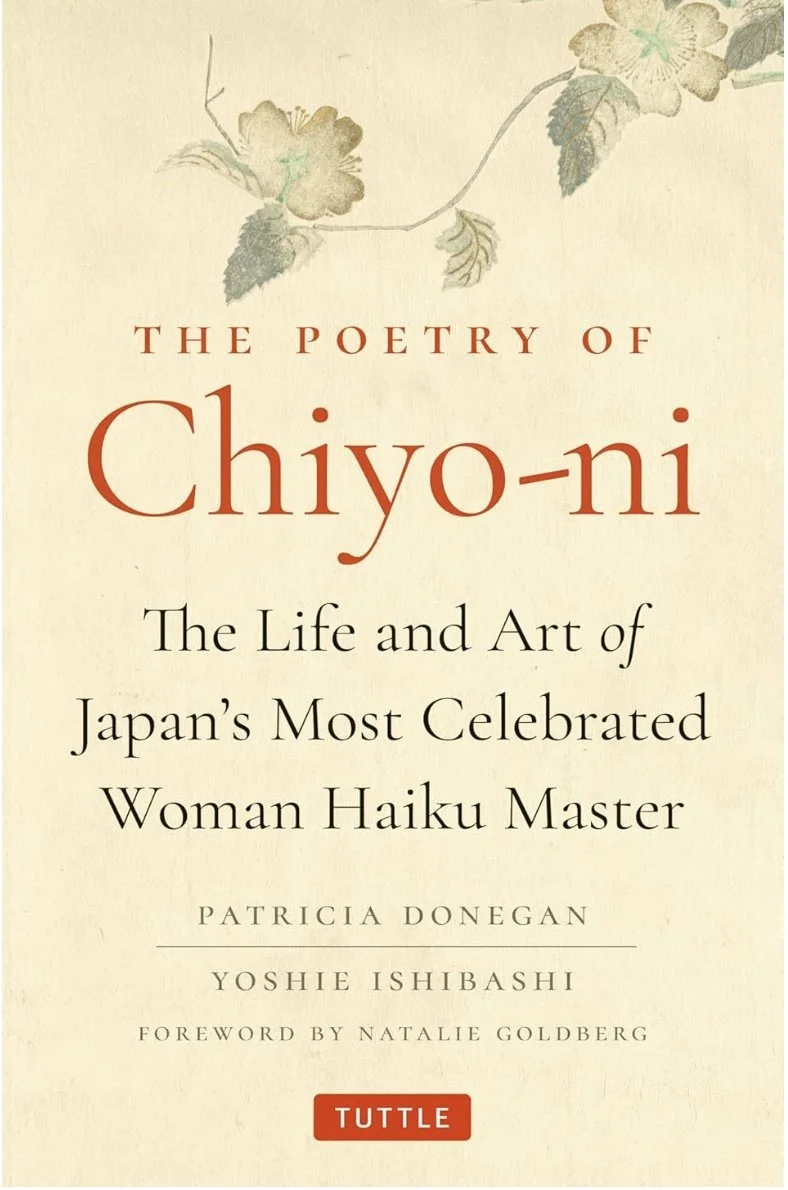
The Poetry of Chiyo-ni
The Life and Art of Japan’s Most Celebrated Woman Haiku Master
by Patricia Donegan and Yoshie Ishibashi
What It’s About
This book introduces the life and work of Chiyo-ni (1703–1775), one of Japan’s most celebrated haiku poets and a woman who built a literary life in a world that rarely made space for women. She was a poet, an artist, and later a Buddhist nun.
The book is thoughtfully structured. It begins with her life and the world she lived in, then moves into her poetry. The haiku appear in multiple forms: romanized Japanese, English translation, and Japanese characters, followed by helpful explanations that offer cultural or historical context. Throughout, there is artwork, calligraphy, and visual material that deepen the sense of who she was and how she saw the world.
This is not a book to rush through. You have to slow down and savor it.
What Stuck With Me
What stayed with me most was the combination of beauty and density. The biographical sections are rich and, at times, academically heavy, but they never felt pointless. They made her life feel substantial rather than mythologized.
The haiku themselves are delicate and exact. They reflect a way of seeing that holds beauty and clarity at the same time. I needed the notes and explanations to understand some of them, and I appreciated having that guidance. Others I understood immediately.
One haiku in particular felt immediately clear:
no more waiting
for the evening or the dawn —
touching the old clothes
Knowing this was written as she was becoming a nun gave it weight. It reads like a moment of release, but also loss. A letting go of one life and the tenderness of what came before it. I didn’t need help understanding this one. It was clear and so were all the feelings it expressed.
The artwork included in the book felt like another way into her world. Calligraphy, prints, and visual pieces that echoed the poems rather than decorating them. Together, the poetry, the context, and the art created a sense of intimacy without sentimentality.
Would I Recommend It
Yes, without hesitation.
This is a slow, intentional book. It’s for readers who enjoy poetry and are willing to take their time. It’s especially well suited for those interested in haiku, Japanese literature, or women’s literary history. It also works as a reference book, one you return to rather than finish and shelve.
This is not for someone looking for a light introduction or a quick read. The life sections are dense, and the book asks for attention. But if you are open to that, it offers a lot in return.
I can see myself going back to this often. Especially in moments when I need to recenter. To slow down. To let my mind rest on something quiet and precise.
Thank you to Tuttle Publishing for gifting me this copy. I will cherish it.
Where to Read:
This post may contain affiliate links. If you make a purchase through these links, I may earn a small commission at no extra cost to you.
Buy on Amazon , Bookshop.org
First time on Bookshop.org? Click for discount code
Looking for your next read?
My Asian Era is where literature meets culture, thoughtful reviews, quiet voices, and stories worth slowing down for.
