
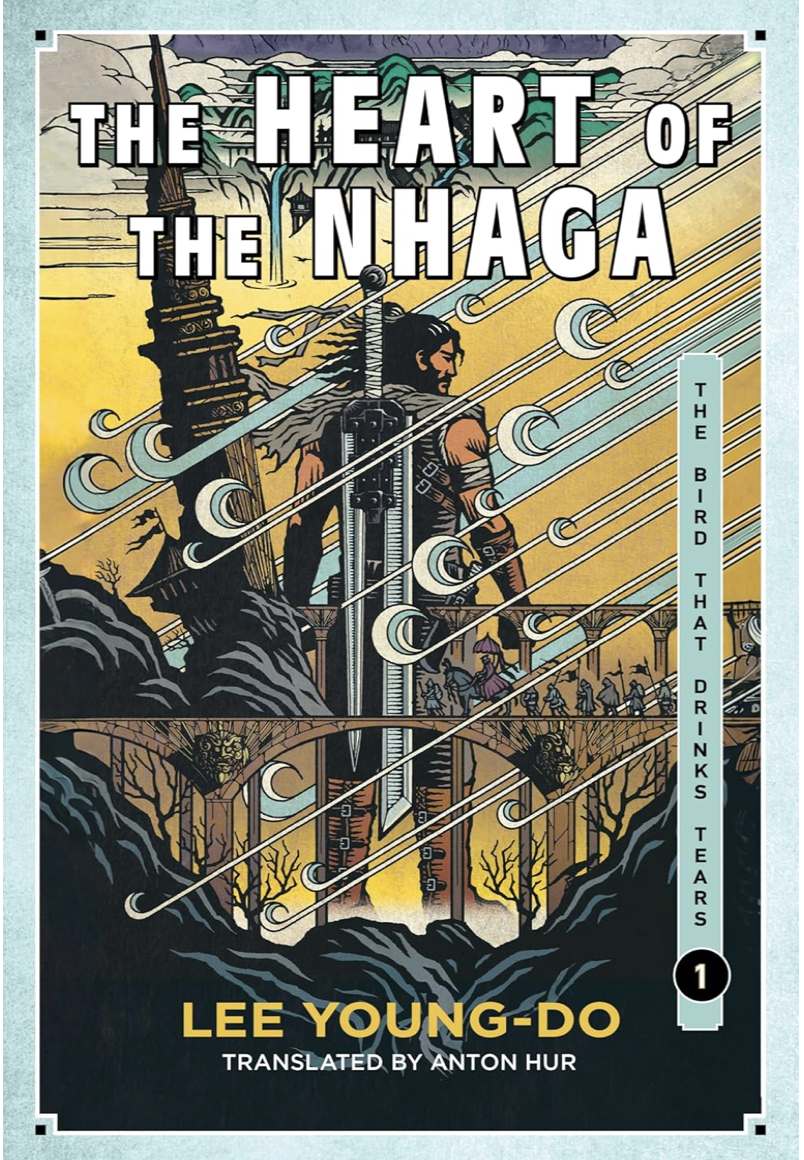
The Heart of the Nhaga
by Lee Young-do
translated by Anton Hur
Where to purchase: Bookshop.org | Amazon | Libro.fm
ARC received from Harper Voyager via NetGalley in exchange for an honest review.
A note before we get into it: I first found this book in an Italian bookstore years before it existed in English. I tried the Italian. The fantasy vocabulary defeated me, and I set it aside. I looked it up, discovered no English translation existed, and waited. This is that translation. It still was not an easy read, and I missed the publication date getting through it. I do not regret any of it.
What It's About
The Heart of the Nhaga is the first English translation of Lee Young-do's landmark Korean fantasy series The Bird That Drinks Tears, originally published in Korea in 2003. The world is split by the Line of Limit. To the north: the Tokkebi, fire-wielding folk who can shape flame into weapons and illusions; the Rekon, giant birdlike warriors; and humans, as fractured and unpredictable as the other races are unified. To the south: the Nhaga, a reptilian people who have surrendered their hearts in exchange for immortality.
When a Nhaga is set to head north on a secret mission, three escorts are dispatched to bring him through alive, one from each northern race. They arrive to find him murdered. The replacement sent in his place still has his heart, which makes him dangerously vulnerable to everything that follows. Four people from four worlds, none of whom are sure they can trust each other, have to complete this mission before it kills them all.
Anton Hur translates.
What Stuck With Me
I should say upfront: epic fantasy is not my usual territory. It took me until about the 30% mark before everything came into focus. The descriptions of the world and the characters are detailed, and I had to read over some of them more than once to fully understand. That is my weakness, not the book's or the translation's. Once everything fell into place I was set.
Now if you know me, you know I am always looking for something a little deeper. Reading this I kept wondering whether some of the scenes and characters came from Korean mythology, folk tradition, or history. In a few places there seemed to be an inside joke of sorts, one you might miss on first read. The name Marunarae, for example, breaks down as maru(mountain peak) and narae (wing): mountain cloud. In this case, mountain cloud with teeth. The Tokkebi, too, are rooted in the Dokkaebi of Korean folk tradition. If you think something in this book might mean more than it appears to, take a moment and look it up. I think it adds enormously to the story.
My Takeaway
Anton Hur pulls off something difficult here. He keeps the sophistication of the source material and makes it accessible without oversimplifying. The density that may challenge you in the early chapters is the same density that makes the world feel real once you are inside it. That balance required a careful hand.
If epic fantasy is already your reading world, this book will deliver. Lee Young-do is often compared to Tolkien, and after reading this I understand why. The world-building has that same sense of a fully articulated universe that exists beyond the edges of the page. If you are newer to the genre, push past the 30% mark. It will reward you.
I am already looking forward to the next one.
Read it.
ARC received from Harper Voyager via NetGalley in exchange for an honest review.
If You Liked This
Seon Jung is a Korean American fantasy writer just starting out. His debut, The Book of Taba: Malapace, Mutants, and Misfits, introduced a world worth paying attention to, and his second book, The Book of Queenie: The Scale of Limbo(Souls of Malapace, Book 2), is a real step forward. Book 3 is on the way. If you want to get behind a writer still building his craft, now is a good time.
For something in a completely different register: Anton Hur's own novel, Toward Eternity (HarperVia, 2024), is speculative fiction that explores mortality, language, and what it means to be human against the backdrop of AI. It shares nothing in tone or setting with The Heart of the Nhaga, but if this book made you curious about the translator's voice, it is worth knowing he writes as well as he translates.
