
Midnight Timetable
by Bora Chung
translated by Anton Hur
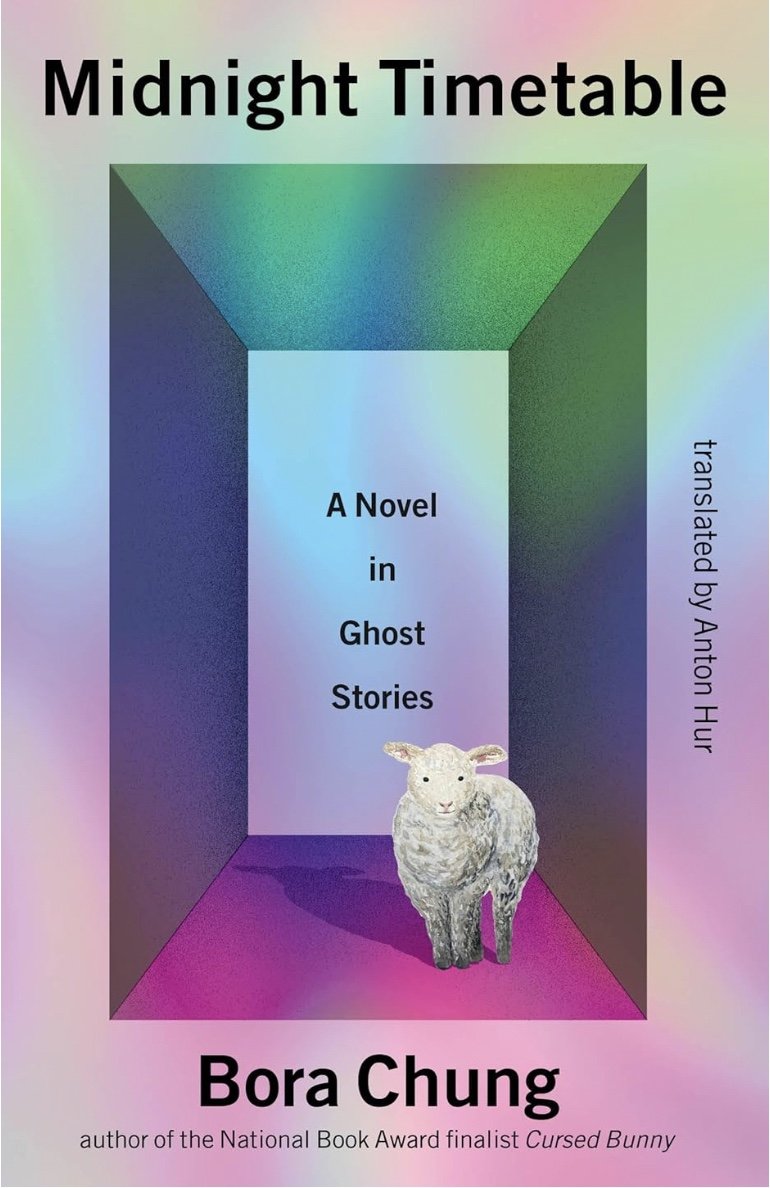
Purchase from Amazon | Bookshop.org
My Asian Era Book Club’s February Read by my favorite dynamic duo.
Do you like ghost stories? Bora Chung does.
What It's About
There is a research facility called the Institute. It employs security staff, has a deputy director, and an employees' lounge. It also houses cursed objects, a ghost cat, sheep that were experimented on and can now see the future, and a never-ending tunnel that some employees find and never quite escape.
This is a novel in ghost stories, and the bureaucratic normalcy of the setting is part of what makes it so effective.
Of course there is an Institute. Of course someone has to work the night shift.
What Stuck With Me
I have now read enough Asian speculative fiction to start noticing things that recur. The one-handed woman appears here, and she is not the first I have encountered. In Buddhist iconography, a broken or single arm on a female figure represents intense, focused compassion, the kind that operates through limitation rather than in spite of it. Unlike multi-armed deities whose many hands suggest ease and varied action, the single-handed figure represents effort that costs something. Chung's blind, one-handed head of security at the Institute carries that weight. She is the one who sees most clearly in a building full of things nobody else wants to look at directly.
The sheep were my favorite. Wounded, experimented on, and somehow able to help a shaman-like character see the future. In Asian mythological tradition the sheep is not simply an animal. The Xiezhi, a divine sheep-like creature in ancient Chinese mythology, was believed to possess the ability to distinguish right from wrong, to perceive truth where humans could not. Judges wore its image to symbolize impartiality. Chung's suffering, prescient sheep carries that lineage. I have only encountered this quality of ethereal sheep in one other book, Murakami's Strange Library, and I do not think that is coincidence. I think both writers are drawing from the same deep cultural well.
The cats are another thread. In Midnight Timetable a cat is killed and comes back to tell its story. Brutally, with clarity, without sentimentality. If you read Kafka on the Shore you know that particular weight. Bora Chung and Murakami are not the same kind of writer but they both understand what a cat carries.
Chung includes an afterword where she talks about where each story came from, including her own experience with a tunnel. I appreciated being let in. It made the book feel like a conversation rather than just a collection.
The social commentary runs underneath everything. Animal testing, domestic abuse, the way men justify possession of women. All there.
Anton Hur translated this. He and Bora Chung are my favorite dynamic duo. He translates her work into English. She translated his debut novel Toward Eternity into Korean. Both authors in their own right, both devoted enough to each other's work to give it that kind of attention. They are auto-reads for me.
Would I Recommend It
Yes, with some honesty about what you are getting into.
This is dark, strange, funny in a bone-dry way, and completely its own thing. If you read Cursed Bunny and Your Utopia and wanted more, this delivers more. If you are new to Bora Chung, this is a perfectly good place to start as long as you are comfortable with horror that doubles as social criticism.
My Takeaway
The Institute exists to take care of things that have nowhere else to go. So does this book.
If you like this you may also like:
Cursed Bunny by Bora Chung — the collection that introduced her to English language readers and earned the Booker shortlist
Your Utopia by Bora Chung — her second collection, cooler in tone but equally precise
The Strange Library by Haruki Murakami — for the particular quality of strangeness they share
