
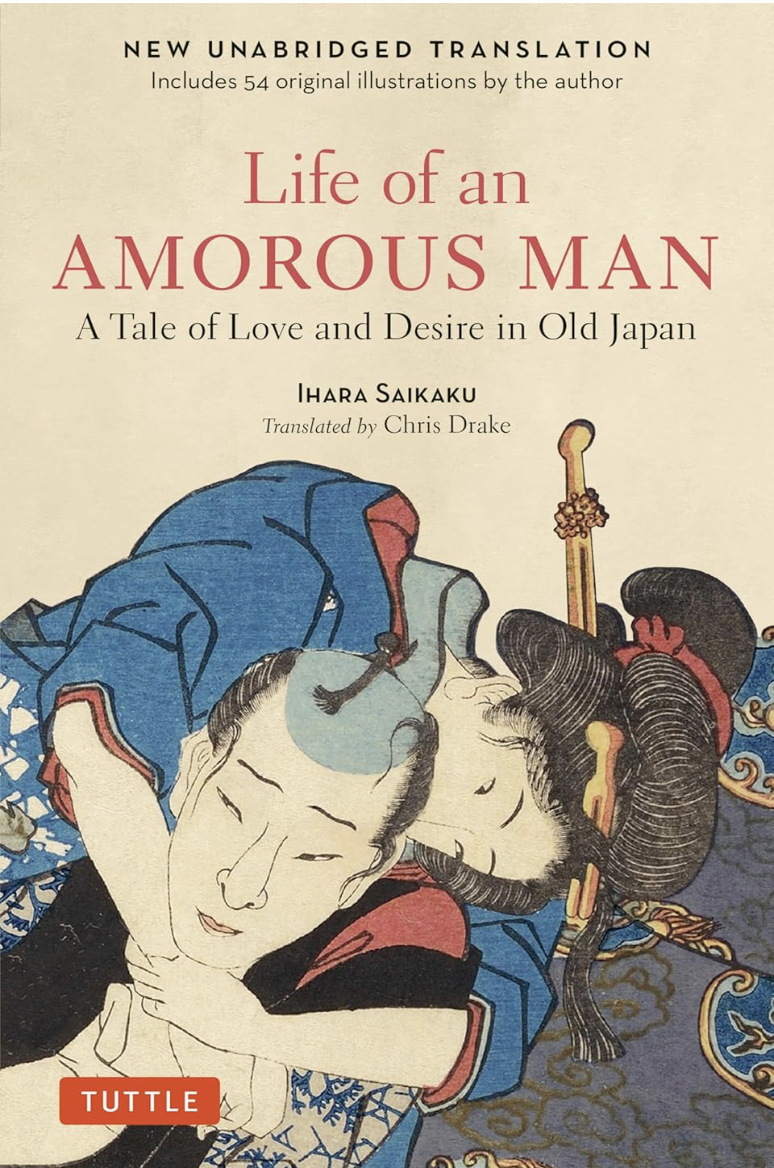
Life of an Amorous Man
by Ihara Saikaku
translated by Chris Drake
Purchase on Amazon | Bookshop.org
Thank you Tuttle Publishing for the gifted copy.
What It's About
Life of an Amorous Man is a classic Edo-period Japanese text that follows the life of a man who spends his years chasing pleasure, love, and desire in nearly every form available to him. He moves through relationships with women, men, actors, courtesans, and lovers across social classes, cities, and stages of life.
This is not a single love story. It's a life lived through appetite. And in the process, it becomes a portrait of an entire social and sexual economy that existed very openly in this period of Japanese history.
What Surprised Me
The tone surprised me. There are moments that are indulgent and even funny, but underneath that is something sad and a little cynical. This is a person's life, not a punchline. If I were describing it to a friend, I'd probably say something like: this book is wild and then immediately follow that with how much it taught me about the lives of philanderers during the Edo period. Not just the men, but the women and actors and courtesans who moved through this world with their own forms of power and vulnerability.
The narrator himself is an overindulgent romantic. He loves pleasure. He loves sex. He loves love. It doesn't always matter who that love is directed at. I didn't expect that, but it felt honest to the period and to the character. This isn't a book that pretends desire fits neatly into modern categories.
What It Made Me Think About
What really stayed with me was how clearly this book shows power dynamics. Who had it. Who didn't. How it shifted depending on money, beauty, age, reputation, and circumstance. And especially how women, not wives, but working women, used their bodies as their means of survival and influence. Reading this alongside other women's perspectives from Japanese literature made that contrast even sharper. Here you're seeing the world through the eyes of someone who benefits from that system, even as he's shaped by it. The discomfort of that dual perspective is part of what makes the book worth reading.
The book doesn't ask you to like him. Sometimes it invites judgment, but more often it just lets you observe. His loves, his foolishness, his excesses. The ending felt earned, both funny and tragic at once, which felt exactly right for a life like this.
The Edition Itself
I want to be deliberate about mentioning this: the Tuttle edition is something special. The illustrations aren't decorative. They're doing real narrative work. There's an image early on of figures arranged by status and proximity that tells you more about the social hierarchy of pleasure quarters than a paragraph of explanation could. This book feels like an object meant to be held and revisited. If you're going to read it, this is the edition to read it in.
Who This Is For
This is for the reader who is genuinely curious about how desire, class, and survival intersected in Edo-period Japan and who doesn't need a book to make moral judgments on their behalf. It rewards patience and an open mind. If you've ever wanted to understand the social architecture of a world completely unlike ours, this offers a rare and vivid window into one.
My Takeaway
He loved love. And in that world, I'm not sure love meant what we think it does now.
