
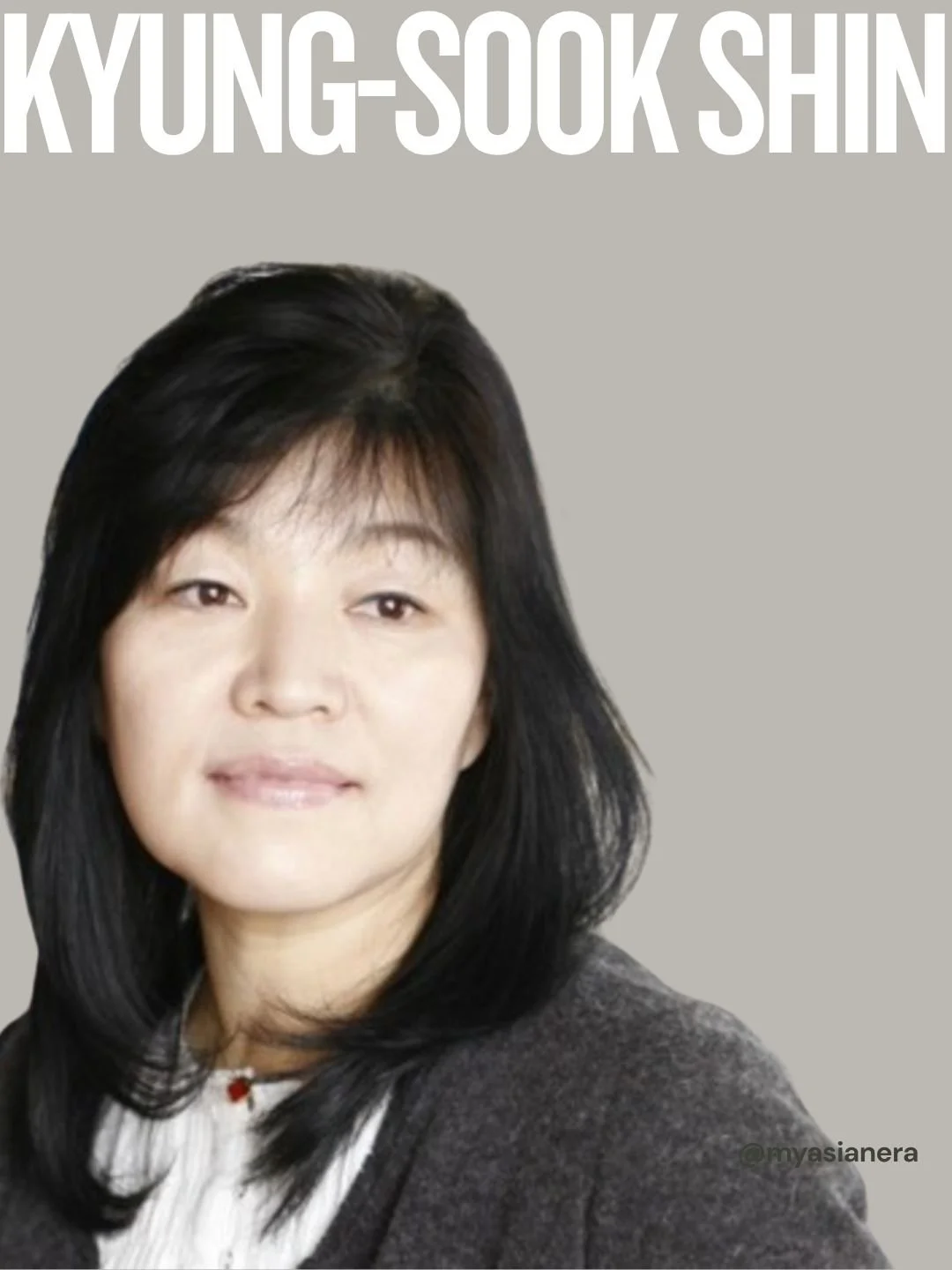
Kyung-Sook Shin
The Author Who Opened Korean Fiction to the World
This post contains affiliate links. If you purchase through my links, I may earn a small commission at no extra cost to you.
Author Spotlight
The first book I read by Kyung-sook Shin was Violets. I kept seeing it pop up in the book stores during my travels. In Seoul, at Kyobo Book Centre Gwanghwamun, then again in a small bookstore in Thailand. It wasn't until I was standing in the Tsutaya Bookstore on Level 1 of the Intermark Mall in Kuala Lumpur, right off the DoubleTree lobby, that I finally picked it up and did not put it back down. It was one of the early books that set me moving in my journey with Asian literature, and I have been following Kyung-sook Shin ever since.
Shin (신경숙) left home at sixteen to work in an electronics plant in Seoul while attending night school. She made her literary debut in 1985 after graduating from the Seoul Institute of the Arts as a creative writing major with her first novella Winter's Fable. Her rise was so fast that Korean readers gave it its own name: the Shin Kyung-sook Syndrome.
She won the 2011 Man Asian Literary Prize for Please Look After Mom, becoming the first woman to receive that honor. The novel became a New York Times bestseller and has been published in more than forty countries.
What She Writes
One of the things I really enjoy in Kyung-sook Shin’s writing is how it often is about families, with all the love and all the cost of that love sitting right next to each other on the page. She writes about the people who hold a family together and what it does to them. The labor that goes unacknowledged for decades, the distance that accumulates between people who love each other, the realization that you did not really know the person you thought you knew best. Her subject is ordinary Korean life across the twentieth century, the industrialization, the political upheaval, the enormous social change, but she gets to all of it through individual lives.
Her prose is lyrical without being difficult. She writes about the body, about what a person looks like when they are exhausted or grieving or trying not to show either. She is one of the most emotionally precise writers I have read, and she does it without sentimentality. You feel every emotion she puts on the page.
She belongs to a generation of Korean female writers who came of age during the authoritarian period of the 1970s and 80s and helped establish a new space for women's voices in Korean literature. Reading her now, it is hard to imagine the literary landscape she was writing into. She was the change.
The Books I Have Read
I want to be honest here: I have not read everything Shin has written in English. What I have read are the three books I am going to tell you about. I will note the others because they belong in the picture, but I will not pretend to a relationship with books yet. But know that I have every intention of reading them and I own most of them.
Please Look After Mom (trans. Chi-Young Kim, Knopf, 2011)
A sixty-nine-year-old woman named So-nyo is separated from her husband in the crowds of Seoul Station. She disappears. What follows is a family searching for her through four narrators: her daughter, her eldest son, her husband, and finally So-nyo herself. Each one loved her. None of them really knew her.
I came to this book carrying my own relationship with my mother, which is not simple, and the book met me exactly where I was. It is about what we take for granted in the people who love us most, and what we are left holding when we realize too late what they gave. It devastated me. It is one of those books that has permanently changed the way I move through the world. I do not think everyone will feel it the way I did. Your life will shape what it does to you. But I think it is one of the most important novels I have ever read for me in my life.
I Went to See My Father (trans. Anton Hur, Astra House, 2023)
This is the companion to Please Look After Mom, and Shin is doing the same thing from the other side. A writer returns to her rural hometown while her mother is in Seoul for medical care, leaving her father alone. She stays to look after him. Over the course of that stay, she uncovers who her father actually was: a man whose life was shaped by the Korean War and the decades that followed, a man with secrets and sacrifices she was never shown, a man more complex and more loving than she had understood.
I came to this one carrying my father too. We did not talk often. There were choices he made that I could not quite forgive. But we knew we loved each other, in that way some fathers and daughters do, even across distance. I was able to be with him when he passed, and I am grateful for that. This book made me rethink about all of it. It is painful in the way I would recommend: the kind of pain that opens something rather than closes it.
Read Please Look After Mom and I Went to See My Father together if you can. They are a diptych, a mother seen by the family she leaves behind, and a father seen by the daughter who finally comes to look.
Violets (trans. Anton Hur, Feminist Press, 2022)
This is nothing like the family novels. San is twenty-two and alone in Seoul, working in a flower shop, haunted by a moment of intimacy from childhood that her only friend turned away from and never forgave. Over one volatile summer she falls into obsession with a photographer, forms a fierce and complicated friendship with a coworker, and navigates a city and a society that barely registers her existence.
It was different from the books I had read up to that point: the particular shape of San's loneliness, the way female friendship and desire and isolation are all tangled together, the way Shin makes you feel the specific weight of being a woman the world has decided not to see. It is short and it is extraordinary. It was one of the books that first pulled me toward Asian literature.
The Other Books in English
I have not read these, but they belong on your radar.
The Girl Who Wrote Loneliness (trans. Ha-yun Jung, Pegasus Books, 2015) is Shin's most autobiographical novel, drawing directly from her years as a teenage factory worker in Seoul. It is the origin story underneath everything else she has written.
I'll Be Right There (trans. Sora Kim-Russell, Other Press, 2014) follows four college friends in 1980s Seoul through love, loss, and the particular intensity of that season of life. It is her most beloved novel among Korean readers after Please Look After Mom.
The Court Dancer (trans. Anton Hur, Pegasus Books, 2019) is her historical novel, set in the final years of the Joseon Dynasty. It follows a court dancer who accompanies a French diplomat to Paris and finds herself caught between two worlds. A completely different register from everything else she has written in English, and by all accounts, a beautiful one.
Where to Start
Start with Please Look After Mom if you are coming to Shin for the first time. It is the book that introduced her to the world. It will tell you quickly whether her work is for you.
Start with Violets if you want something shorter and more unsettling. It is the book I started with, and I have never been sorry.
Start with The Girl Who Wrote Loneliness if you want to understand where she came from before you read where she went.
If You Have Read Her
If you came to Shin through Please Look After Mom, read I Went to See My Father next. The two books are asking the same question from opposite directions, and they are better together than either is alone.
Read Her Free First
"Something No One Else Has" is an excerpt from Violets, translated by Anton Hur, and it is available free at wordswithoutborders.org. It is the opening of San's story and it will tell you everything you need to know about whether this book is for you.
Browse all of Kyung-Sook Shin's available titles at my storefront.
