
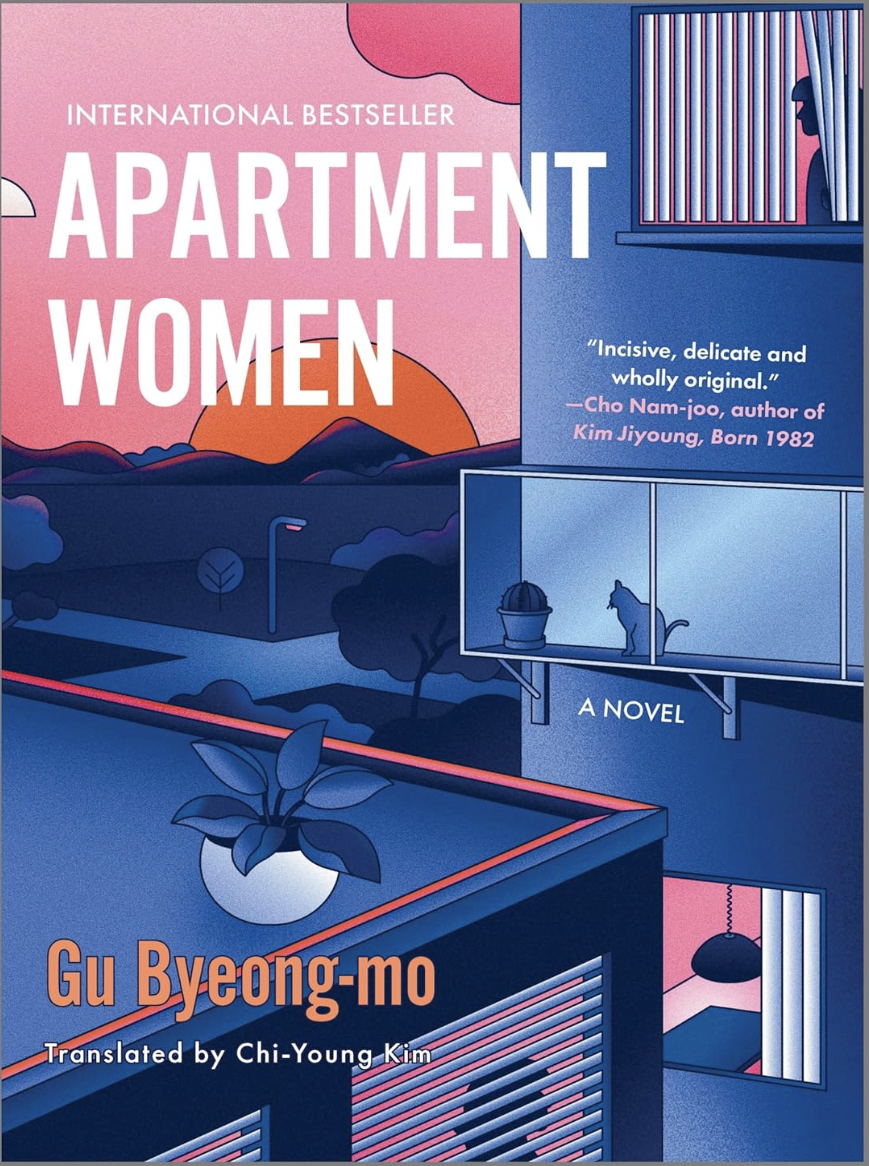
Apartment Women
by Gu Byeong-mo
Translated by Chi-young Kim
Where to purchase: Amazon | Bookshop.org
What It’s About
Yojin moves with her husband and young daughter into a government-run apartment complex outside Seoul called Dream Future Pilot Communal Apartments. Thousands apply, and her family is one of the lucky few selected. It’s not a normal lease. The whole place is built around a national birth-rate initiative. Residents sign on with an expectation: have more children.
The apartments promise community and support. Communal childcare is built into the setup. Shared responsibility. A village.
From the beginning, Yojin feels something is off, and she can’t quite talk herself out of that feeling. And she’s not wrong.
This book follows four women living in the complex as daily life gets more complicated.
What Stuck With Me
I enjoyed reading this. It was sharp but stayed calm while everything underneath it became more tense. It just kept tightening the screws.
It was interesting how fast “community” turned into pressure. The building runs on this polite, social expectation that everyone should participate, everyone should agree, everyone should keep the machine moving. And if you don’t, you’re the problem.
It was a system dressed up as support. The worst part is how normal it looked. Meetings. Rules. Friendly nudges. Group expectations. That soft way people push you until you don’t realize you’ve been backed into a corner.
The communal childcare piece was the most uncomfortable for me. The “it takes a village” line gets used like it’s automatically a good thing. In this building, it isn’t. It becomes a way to make women responsible for everyone’s children and everyone’s feelings, not just their own.
It also made something really clear. Even when the government is the one trying to engineer family life, the enforcement still lands in the same place. On mothers.
I liked that the book didn’t pretend the women were all going to behave nobly. When people are exhausted and under pressure, they get ugly. They get controlling. They get territorial. They start policing each other.
The housing angle matters too. This isn’t just a story about parenting culture. It’s a story about leverage.
Stable housing is hard to get. So people accept conditions they shouldn’t accept. They tell themselves it’s fine. They tell themselves it’s temporary. They tell themselves this is what adulthood looks like.
That’s how this system survives. Not through force. Through need.
Would I Recommend It
Yes. I think it’s worth reading.
I’d recommend this if you like social novels that feel uncomfortably real, but still push things far enough to make the power dynamics obvious. If you’ve been paying attention to Korea’s birth rate conversations, or you’re curious about how policy can creep into private life, this is a good one.
I would not recommend it if you need a fast plot, big twists, or clean villains. This book is more about accumulation. Small decisions. Tiny humiliations. The way people rationalize what they’re participating in.
My takeaway
A “village” can be care, but it can also be control.
FAQ
Is Apartment Women literary fiction or thriller?
It’s literary fiction with tension. It reads like a social pressure cooker more than a plot-driven thriller.
What is Apartment Women about?
A woman moves into a government-run communal apartment complex designed to boost birth rates, where “community” quickly starts to feel like control.
Who should read Apartment Women?
Readers who like social novels about power dynamics, motherhood labor, and systems that quietly shape daily life.
