
by Gu Byeong-mo
Translated by Chi-Young Kim
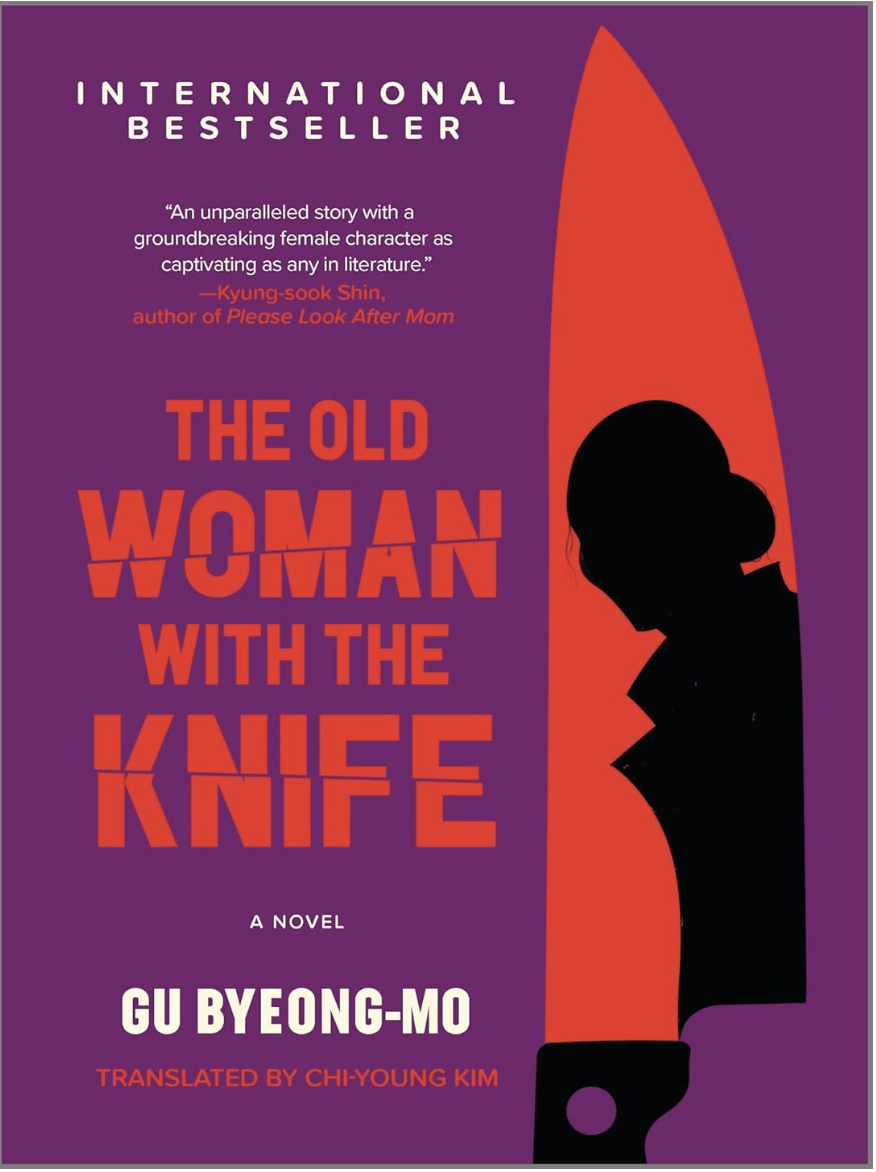
Purchase on Amazon | Bookshop.org | Libro.fm
Hanover Square Press | March 8, 2022
The English edition of this novel was published on March 8, 2022. International Women's Day. That is not an accident.
Hornclaw is sixty-five years old. She has a bad knee, a body that no longer does everything she asks of it, and a profession she has practiced with quiet competence for decades. She is a contract killer. She is also, by the standards of her industry, getting old.
The Old Woman with the Knife is Gu Byeong-mo's third novel, originally published in Korean in 2013 and translated into English by Chi-Young Kim. It was adapted into a film in 2025.
What It's About
Hornclaw works alone. She takes contracts, executes them cleanly, and returns to an apartment she shares with a dog named Deadweight. She is careful, methodical, and invisible in the way older women tend to be invisible in the world. Korean society, like most societies, does not look too hard at women her age. That is both her cover and her grievance.
The plot thickens when a younger assassin enters her orbit, and the past she has kept carefully contained begins to press forward. Gu Byeong-mo is not primarily interested in the mechanics of the thriller, though those mechanics work. She is interested in Hornclaw as a person: what it costs to have lived this particular life, what she has given up, and what she has refused to.
Korean crime fiction has a tradition of darkness without apology, and The Old Woman with the Knife sits squarely in that tradition. But it is also funny, in the way that things can be funny when they are very true.
What Stuck With Me
Hornclaw's age is the whole architecture of this book. In a genre that runs on young, capable bodies, Gu Byeong-mo gives us a protagonist whose body is in negotiation with her. The knee that slows her down. The calculations she makes now that she would not have made at forty. The way she watches younger people and knows exactly what they are underestimating.
This is what Korean crime fiction can do that the genre does not always do elsewhere: it places an ordinary social reality at the center of the thriller. In Korea, as in most of East Asia, older women occupy a particular kind of erasure. They are expected to diminish, to step back, to become background. Hornclaw has weaponized that expectation her entire career. The book asks what happens when the weapon starts to feel its age too.
Chi-Young Kim's translation handles Hornclaw's voice with care. The prose is dry and precise. There is wit in it without any performance of wit. Hornclaw does not announce herself. She does not need to.
The dog, Deadweight, is the emotional center of the book in a way I did not expect. By the time I understood why, I had already felt it.
My Takeaway
This is Korean crime fiction at its most intelligent. It is sharp, it is dark, and it does something unusual: it builds an entire novel around a woman the world has decided to stop looking at, and shows you exactly how much that costs her and how much it has served her.
It is not a long book. It moves fast. But it stays with you after, in the way books do when a character has been drawn so specifically that she keeps showing up in your mind uninvited.
If you like Korean noir, read this. If you have never read Korean crime fiction, this is a good place to start. Korean crime fiction has a whole universe and Hornclaw is an excellent door in.
Where to purchase:
Purchase on Amazon | Bookshop.org | Libro.fm
If you like this you may also like:
The Plotters by Un-su Kim
Diary of a Murderer by Kim Young-ha
This post is part of a Women's History Month series on Asian female writers and the books they write.
