
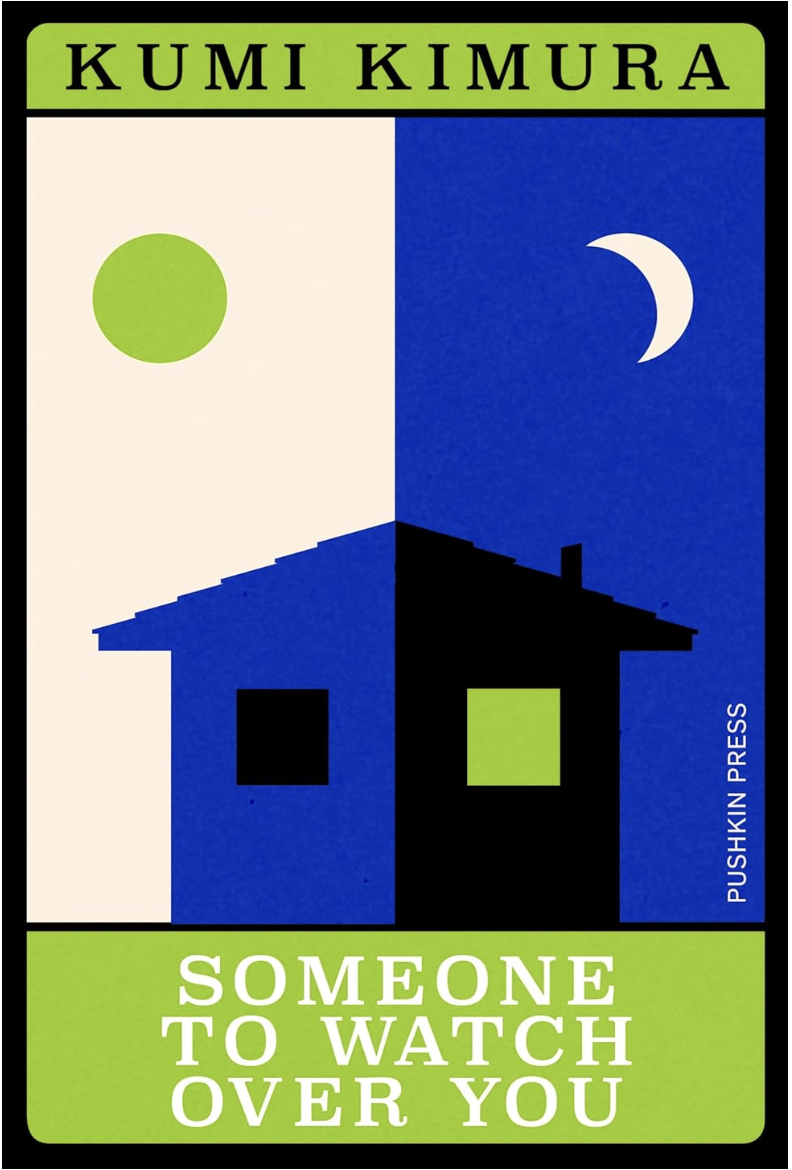
Someone to Watch Over You
by Kumi Kimura
translated by Yuki Tejima
Where to buy: Amazon | Bookshop.org
As an Amazon Associate I earn from qualifying purchases, at no additional cost to you..
What It's About
COVID-era Japan. A former teacher living alone in a small, insular town is being quietly circled by someone she doesn't know. A man with no direction and no place left to stay starts running errands for her, small things at first, then something closer to surveillance: a long commute out to check whether anyone unfamiliar has come near her house. Eventually she offers him a room. Neither of them pretends this is kindness.
What makes their arrangement strange is how little contact they actually have. She is a hypochondriac, and she insists they never see each other. She leaves food outside his door, does his laundry separately while wearing a mask, and they communicate mostly by ringing bells. On some nights she'll talk to him through the fusuma, the sliding paper partition between rooms. That's it. That's the relationship.
This is not a love story. It's a book about proximity. About what it means to share space with another person when the thing you actually need is just to not be alone.
What Stuck With Me
I kept thinking about Japan specifically while I was reading this.
Before COVID arrived, Japan already had a name for dying alone, undiscovered: kodokushi. It wasn't a fringe condition. It was something the country had been sitting with for years, a recognized social reality. When shelter-in-place came, it didn't create that loneliness. It made it impossible to look away from.
Kumi Kimura sets this story inside that pressure, and it shows.
Neither of these two people is easy to like. They are both carrying things they haven't looked at directly, and the arrangement they fall into isn't tender or redemptive. It's transactional in a way that felt completely honest to me.
What got me was the internal logic of how they end up together. She doesn't want him there because she trusts him. She wants to hear someone else in the house. That's the whole thing. It's bleak. And also, in its own uncomfortable way, true.
Because during that period, plenty of people who deserved company didn't have it. And these two, these specific two, found each other. I'm not sure how I feel about that. I don't think you're supposed to.
My Takeaway
This is not a redemption story, and it doesn't try to be. Kumi Kimura has been shortlisted twice for the Akutagawa Prize, Japan's most prestigious literary award, and this is her first novel translated into English. It shows why that matters. If you read Japanese literary fiction for its willingness to sit in moral discomfort without flinching, this belongs on your list. Yuki Tejima's translation keeps the prose tight and controlled, which is exactly what this story needs.
It's a short book. It reads fast. It doesn't leave fast.
Gifted copy from Pushkin Press. All opinions are my own.
Where to purchase: Amazon / Bookshop.org
