
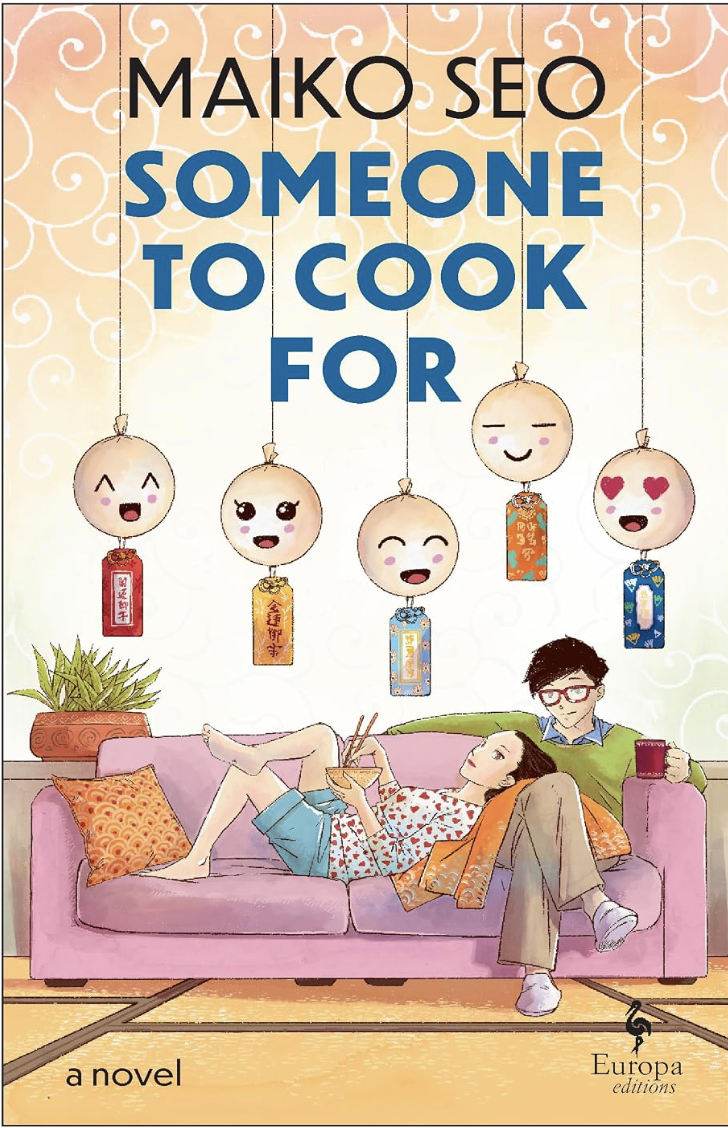
Someone to Cook For
by Maiko Seo
Translated by Laurel Taylor
This post contains affiliate links, which means I may earn a small commission at no extra cost to you.
ARC Review
Europa Editions
July 7, 2026
I have spent a lot of my life being the steady one, the capable one, the person who notices the rough spots coming and helps keep everything as calm as possible, trying hard not to upset anyone. I recognized Yuko right away. She is the kind of child who decides, very early, that being easy to love is her job. I know that girl. So I came to this book already on her side, which made what happened next more complicated than I expected.
Someone to Cook For is Maiko Seo's first novel in English, translated by Laurel Taylor. What the cover does not tell you is that it already has a life. In Japan this is And So the Baton Is Passed, the book that won the Booksellers' Award and sold over a million copies. It came out there in 2018 and became one of those books everyone read. It is only reaching us in English now. Europa changed the title to put the food up front. I understand why.
Here is the setup, and I will stay vague on purpose. Yuko has had four surnames and several families. Her mother dies when she is young, her father leaves for Brazil, Yuko is left with her step-mother who leaves, comes back, leaves again, marries men and unmarries them, and each time Yuko is handed to whoever stays. None of these parents are related to her by blood. All of them, in their clumsy ways, love her. The last of her fathers is the one who cooks. He makes her a real breakfast on the first day of school. When she is miserable over a fight with classmates he makes gyoza until there is a mountain of them and the misery has nowhere left to go. Food is how they say the things they cannot quite put into words.
The book's whole argument is that Yuko's childhood is not a tragedy. There is no bitterness in her. She keeps finding her footing, and Seo wants you to read that as strength, as a different and truer kind of family. For long stretches I went along with it. And then I would remember the original title. The baton. A baton is a thing you pass, and it has no say in whose hand it lands in next. Once I saw that, I could not stop seeing the other book underneath this one. Change one degree of tone and this is a horror novel. A child moved through a series of men by a mother who keeps disappearing. Seo must know exactly how close she is sailing to that.
I wanted more accountability and remorse from all of these adults. I admired what Seo built, but I wanted more fire from Yuko too, and less of that understated strength I was supposed to accept. I understood Yuko in my bones. But I never quite stopped seeing the version with the lights turned down. I did appreciate what Seo did with the food. Yuko grows up to feed people for a living, and that is the real transformation. The girl who was handed from table to table decides to become the one who sets it. That choice is the whole book, and it is lovely, and it is hers.
I went looking for whether my unease was just me, a reader raised on a different set of stories where this kind of childhood comes with damage attached. Some of it is cultural. This is healing fiction, a tradition that treats acceptance and equilibrium as the what is important rather than as something gone wrong. And Seo is not numb to what she describes. She has Yuko reject the idea that she is a victim, early and on purpose. That refusal is the book. Whether it reads as consolation or leaves you wanting more is the only real question here, and your answer is the difference between loving this book and respecting it.
Translated by Laurel Taylor.
Definitely worth the read.
