
By Hideo Furukawa
Translated by David Boyd
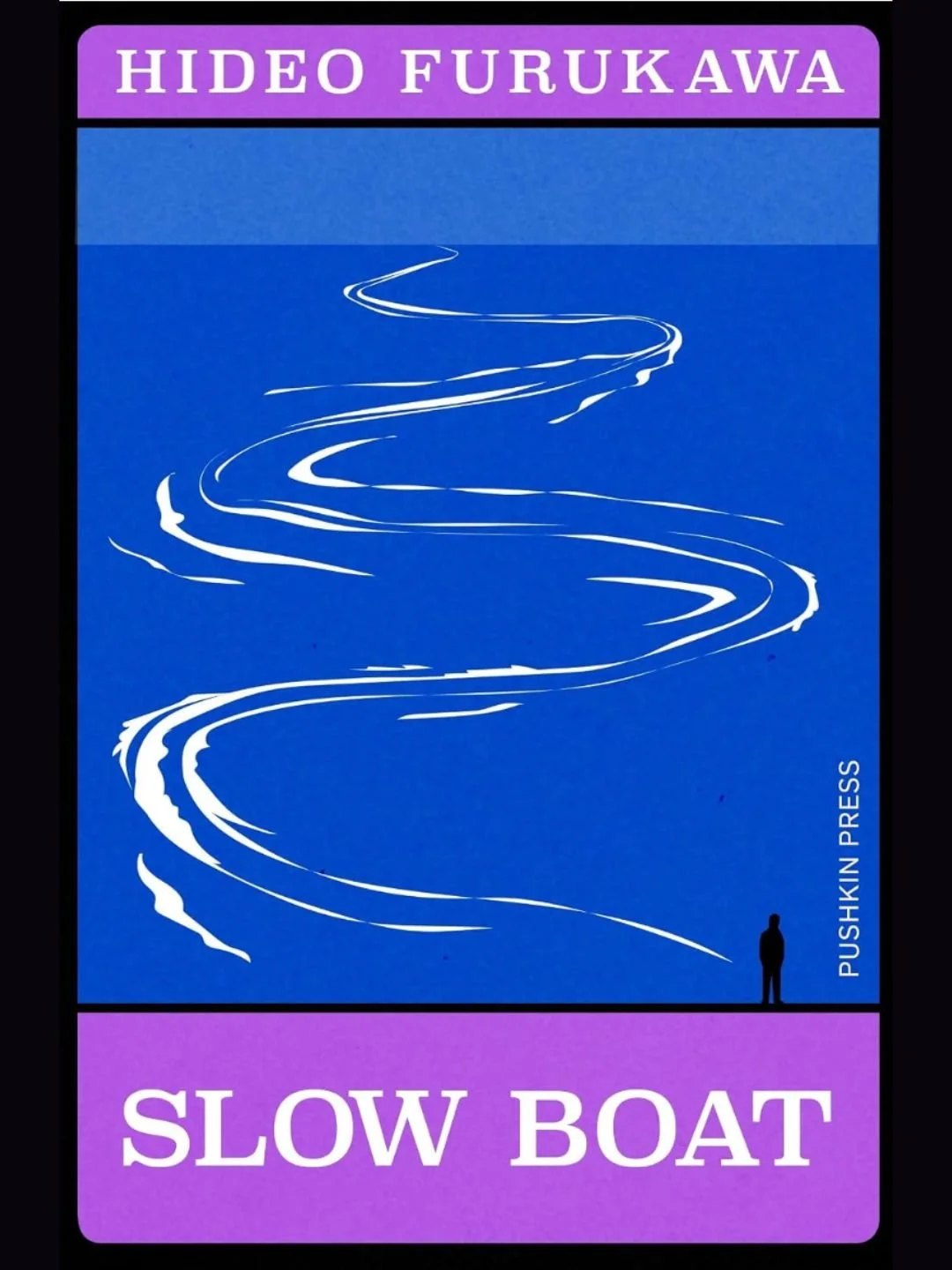
Pushkin Press
I knew the voice but I couldn't put my finger on where from. A few pages into Slow Boat I was sure I had read this writer before, or someone very close to him, and I could not place it. The rhythm was familiar. So was the narrator's flat, funny, half-defeated way of talking about his own life. I kept reading with that itch in the back of my head, and it stayed there until the author told me himself what I was hearing.
Slow Boat is a short novel, part of Pushkin's Japanese Novellas series. The narrator has spent his whole life in Tokyo and hates it, and the book is the record of his failed attempts to leave. Every plan to get out of the city falls apart, mostly because of a woman, and the book moves through three of them. The narrator is funny in a dry, in a self-deprecating way, and his hatred of Tokyo goes past complaint into something closer to a life sentence. He keeps drawing up plans to leave, and Furukawa makes you feel both how badly he wants out and how completely the city holds him in.
The first girl he meets at school when they are young. She talks constantly about strange things, subjects that do not seem to connect to anything, and most people around her have written her off. He is the one who keeps listening. He works out what she is actually saying and finds his way in, and for a while they have something real. Then life happens. The other two relationships follow the same shape. He gets close, something in the world intervenes, and Tokyo keeps him.
Here is what my ear was reaching for. The full title is Slow Boat to China RMX. Furukawa built the book as a remix of Haruki Murakami's short story "A Slow Boat to China," from The Elephant Vanishes. He says so directly in a set of liner notes at the back, where he calls Murakami "the roots of my soul." Murakami's story is a man remembering three encounters with Chinese people across his life. Furukawa keeps the three-part shape and the searching, memory-sifting voice, and turns the three strangers into three lovers.
I love that he tells you. Plenty of writers work in someone's shadow and hope you will not notice. Furukawa hands you the source and asks you to compare. That is why the Murakami comparison, the reflexive thing people reach for with any male Japanese novelist, actually belongs here. He asked for it, and it holds up. The voice is his own, the jokes land, and David Boyd's translation carries the wordplay and the loose, talking-to-you tone without strain.
This is a quick read, exactly what I was looking for when I selected it. The idea underneath it is strong: a man who cannot leave his city, written by a writer who is not trying to leave his biggest influence, but remixing him out in the open instead. I finished it and pulled my copy of The Elephant Vanishes off the shelf to read the original again.
Both are definitely worth the read.
Thank you Pushkin Press for the gifted copy. All opinions are my own.
